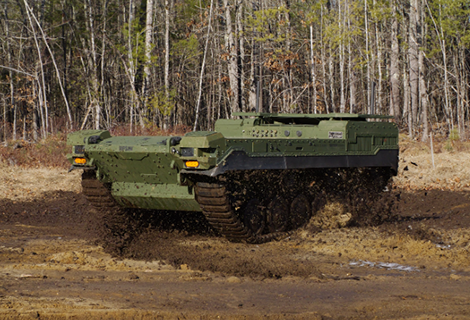
The U.S. Marine Corps is adding robots to its experimentation lineup. Textron Systems announced on November 10, 2026 that the Marine Corps Warfighting Laboratory in Quantico, Virginia, has ordered two Ripsaw M3 uncrewed ground vehicles, a tracked robotic platform built by Textron's Howe & Howe Technologies subsidiary.
What exactly is the Marine Corps buying?
The Ripsaw M3 is a tracked, hybrid-electric robotic vehicle that can carry more than 5,000 pounds of payload and reach speeds above 30 miles per hour. It has a flat deck designed to accept different mission kits, meaning the same chassis could carry sensors one week and a weapons mount the next. Textron built the M3 around a modular open systems architecture, so outside companies can plug their own payloads, controllers and autonomy software into the vehicle without redesigning it.
Only two vehicles are involved in this order, and Textron has not disclosed the contract's dollar value. That is deliberate: the Marine Corps Warfighting Laboratory buys small batches of experimental hardware to test concepts before committing to larger production runs.
Why would the Marines want a robot tank right now?
The Warfighting Laboratory's job is to work out how uncrewed systems should fit into Marine Corps operations before the service writes requirements for a real program. Sara Willett, Textron's vice president of programs, said the M3's speed, agility and multi-mission flexibility suit it to that testbed role. The two vehicles will trial different sensor packages, communications gear and autonomy software, with findings feeding into decisions about what ground robots the Marine Corps eventually buys in bulk.
That mirrors a broader push across the Pentagon toward robotic ground vehicles that can scout, haul supplies or absorb risk that would otherwise fall on Marines. Michael Howe, senior vice president at Howe & Howe, said the M3 is suited to the Marine Corps' demanding environmental requirements, pointing to amphibious and expeditionary operations as a likely proving ground.
How does this fit into the wider robotic combat vehicle market?
The Army, Navy and now the Marine Corps have all run trials with uncrewed ground vehicles in recent years, but few programs have moved past small testbeds into large-scale purchases. Textron's Ripsaw line has been evaluated by multiple services under a contracting vehicle called Other Transaction number W15QKN-17-9-1025 with the National Advanced Mobility Consortium, which lets the Pentagon experiment with new hardware without a full traditional procurement process.
The M3 competes in a crowded field that includes General Dynamics' TRX and various smaller robotic mule platforms designed to carry gear for infantry units. What sets this order apart is that it is the Marine Corps' turn to run the experiment, which could open the door to a dedicated Marine robotic ground vehicle requirement if the Warfighting Laboratory's findings are favorable.
What happens next?
The two Ripsaw M3s will head to Quantico for integration work, where engineers will fit them with sensors and autonomy packages chosen by the lab. There is no public timeline for when results will be published or when a larger order might follow. Given how the Pentagon has handled similar robotic ground vehicle trials, a verdict on wider adoption likely won't arrive for at least a year or two, according to The Defense Post.