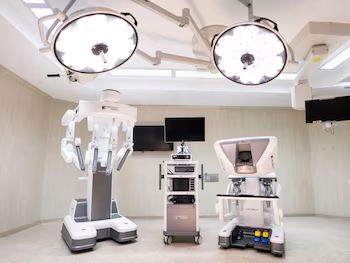
Doctors at Hospital Italiano in Buenos Aires completed what they describe as Argentina's first international telesurgery on November 27, with a specialist in São Paulo, Brazil, remotely controlling parts of a robotic procedure from 1,600 kilometers away. The operation used MicroPort MedBot's Toumai surgical robot and ran with latency under 40 milliseconds, according to Infobae.
The procedure repositioned a patient's uterus after cancer treatment had displaced it. Dr. Diego Odetto led the operation from the Buenos Aires console while Dr. Marcelo Vieira, a robotic gynecological surgery specialist in São Paulo, observed in real time and took control of the instruments during specific stages, a setup the hospital calls teleproctoría. The Argentine team retained overall command throughout. The surgery lasted about three hours, and the patient was discharged after 24 hours.
A fast expansion of robotic surgery in Argentina
Hospital Italiano brought Toumai into its operating rooms in September 2025, and the broader numbers around it are notable: Argentina's hospitals went from fewer than six robotic surgical systems to more than 30 in roughly two years, spreading the technology from urology into gynecology, general surgery and now cross-border collaboration. Toumai, built by Shanghai-based MicroPort MedBot, competes directly with Intuitive Surgical's da Vinci line and has been positioning itself in Latin America as a lower-cost alternative with remote-connectivity features built in from the start.
Why low latency is the real story
Telesurgery has been demonstrated before, including over 5G networks in China, but reliability at under 40 milliseconds is what makes a remote surgeon's input usable mid-procedure rather than just advisory. At higher latency, a specialist watching a live feed can talk a local surgeon through a step; they cannot safely take the controls themselves. The teleproctoría model used in Buenos Aires splits the difference: the visiting specialist gets hands-on control for defined stages while the local team keeps ultimate authority and can take back the console instantly.
That distinction matters for how hospitals in countries with uneven access to subspecialists might use the technology. Rather than flying a rare specialist in for a single case, or sending a patient abroad, a hospital could bring that expertise in over a network connection for the specific portion of a procedure that needs it. If the approach holds up across more cases and specialties, it could become a template for regional surgical networks across Latin America, where travel distances between major hospitals are often far greater than the 1,600 kilometers between Buenos Aires and São Paulo.