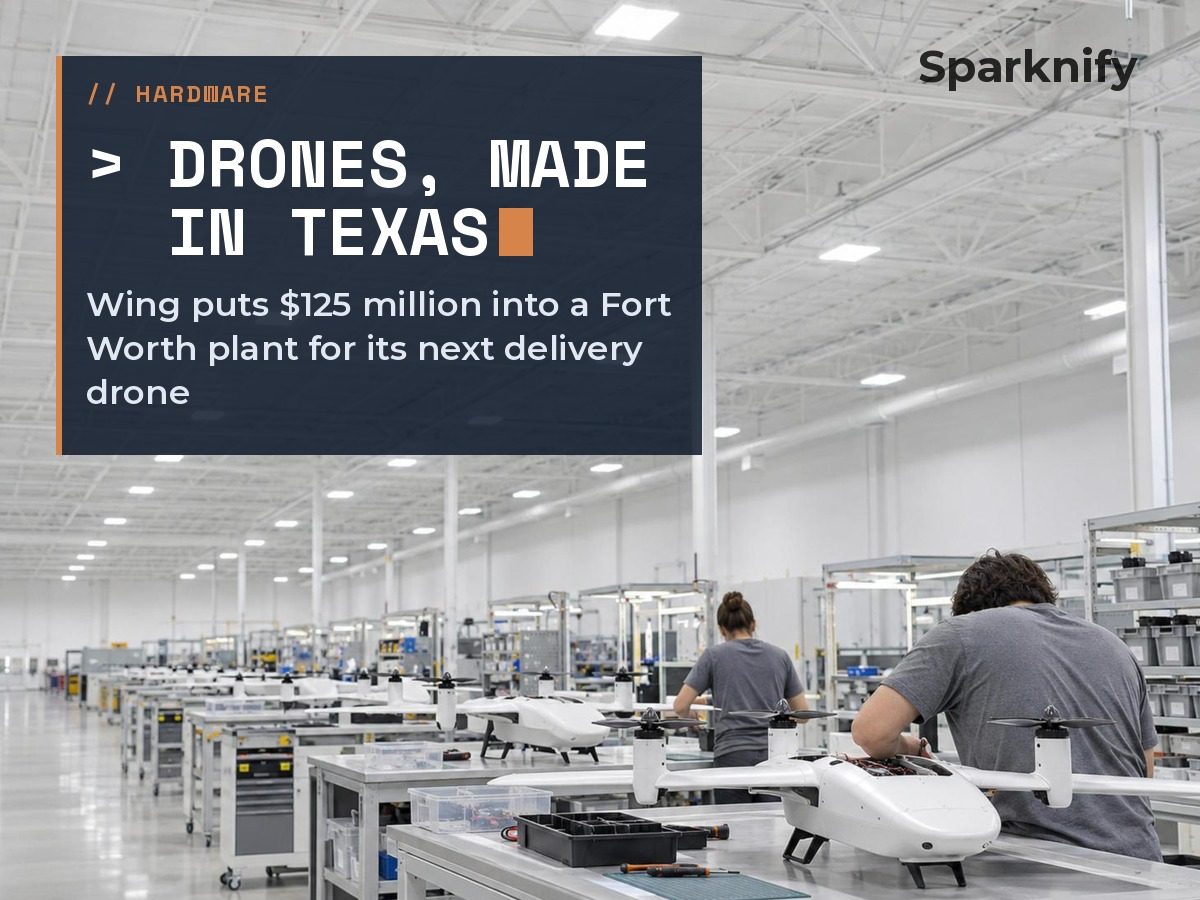
Alphabet's drone delivery subsidiary Wing is committing up to $125 million over the next two years to build a dedicated drone manufacturing facility in Fort Worth, Texas, capable of producing tens of thousands of aircraft a year. The company announced the investment on November 6, marking its first move from small-batch assembly to industrial-scale production.
The 15,000-square-foot facility will create up to 100 manufacturing jobs and will build Wing's next-generation delivery aircraft entirely on US soil. Wing CEO Adam Woodworth said drone delivery "has become a global reality, driven by clear demand from our partners and their customers," adding that building domestically advances American aviation innovation as the company scales its operations, according to DroneLife.
Why a factory, not just more drones
Wing already runs more than 70 delivery hubs across the US and logged over a million home deliveries in 2026, according to the company. Until now, those aircraft have come from relatively small production runs — a model that works for a handful of pilot markets but becomes a bottleneck once a company tries to serve dozens of cities at once.
A dedicated factory changes that math. Producing tens of thousands of units annually would let Wing stock new markets faster, replace aircraft lost to weather, wear or accidents without lead-time delays, and bring per-unit costs down as volume rises — a dynamic familiar from automotive and consumer electronics manufacturing but still rare in commercial drone delivery. Wing has said it wants to reach nearly 20 US markets and more than 40 million Americans by 2027, a target that is difficult to hit without a reliable domestic supply chain.
The timing also lines up with regulation. The FAA is moving toward Part 108, a rule that would replace today's patchwork of site-specific waivers for beyond-visual-line-of-sight flight with a standardized national framework. Domestic manufacturing positions Wing to meet the aviation-grade reliability and supply-chain requirements regulators are expected to demand once BVLOS operations go mainstream, rather than scrambling to adapt an overseas supply chain to US certification rules.
A crowded, fast-growing field
Wing is not alone in chasing manufacturing scale. Walmart's drone partner Zipline raised $1.5 billion at a $21.5 billion valuation this year and has its own production ambitions, while Amazon's Prime Air and DoorDash's newly launched in-house drone program are both building or sourcing aircraft to support expansion plans of their own. Each company is betting that the limiting factor in drone delivery is shifting from regulatory approval to hardware throughput.
Wing's advantage is a decade-long head start: it was the first drone delivery company to win FAA Part 135 air carrier certification back in 2019, and it has kept flying through years when rivals paused or retooled. A US-based factory also insulates Wing from tariff exposure and import restrictions that have complicated supply chains for other robotics and drone makers this year.
The Fort Worth facility is expected to come online within the two-year investment window. Whether Wing can translate manufacturing capacity into actual market share against Amazon, Zipline and a fast-moving DoorDash will depend on how quickly the FAA finalizes Part 108 and how many retail partners sign on for drone delivery at scale.