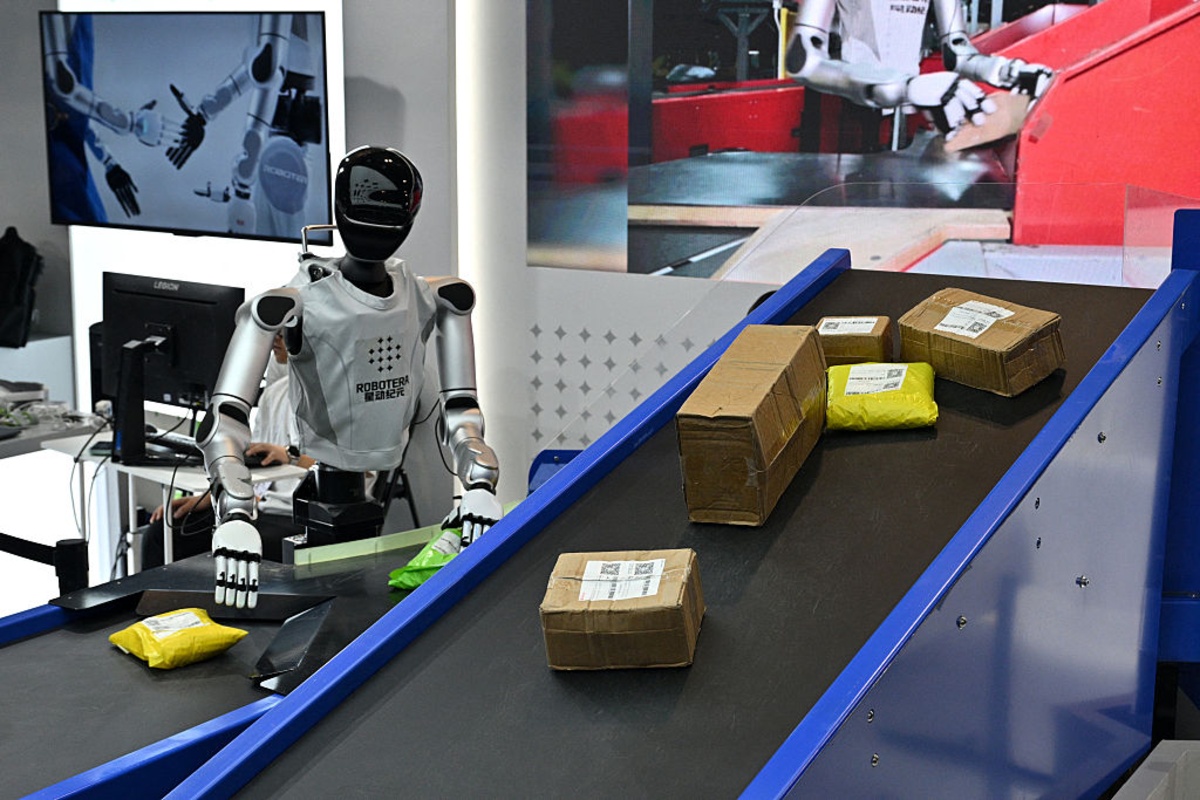
Brooklyn third-party logistics provider Highline Commerce confirmed on July 23, 2026 that Ultra Robotics’ Operator OP1 humanoids fill up to 30% of client e-commerce orders on its Sunset Park warehouse floor — the first commercially verified task-share figure from a mid-market 3PL running humanoid robots outside the Amazon and automotive ecosystems.
What The 30% Number Actually Covers
The workflow the OP1 handles is the linear e-commerce pipeline: pick an item from a bin, drop it in a tote, scan it, push it to a conveyor. Highline serves more than 200 direct-to-consumer brands from a 60,000-square-foot Industry City facility, and the SKU mix — consistent packaging and predictable geometries — is the kind of environment two-finger grippers handle reliably. The remaining 70% of orders still involve item classes today’s humanoid platforms don’t yet handle at commercial speed.
Why The OP1 Runs 24/7 On A 120V Outlet
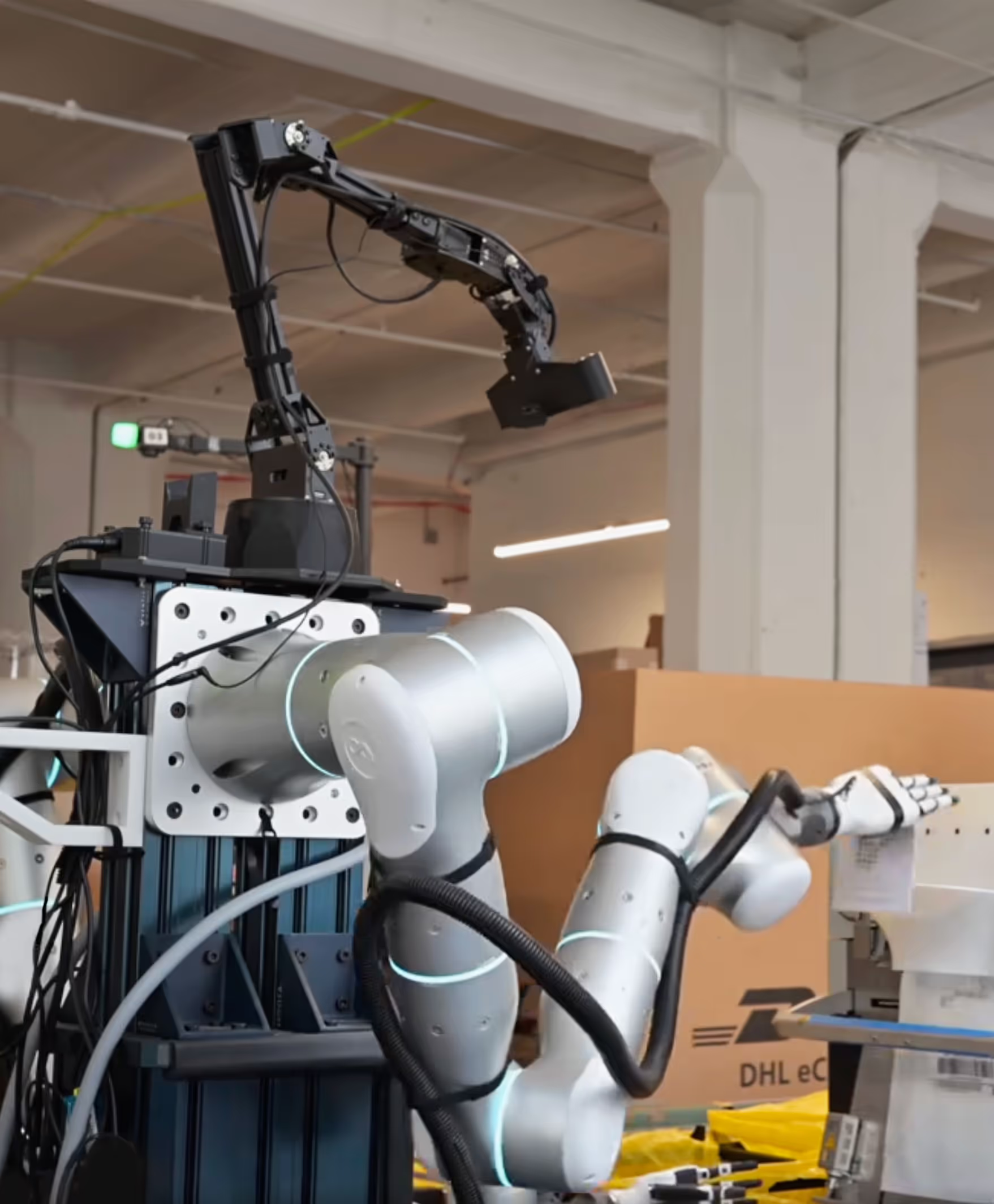
The OP1 is not bipedal. It is a 180 cm, 140 kg stationary dual-arm system on a locking wheeled base, with 14 degrees of freedom, a 10-by-10-foot work cell, and grippers rated at roughly 5 kg per arm. RGB cameras feed an on-device vision-language-action network at 10 Hz — no cloud dependency — and the robot plugs into a standard 120-volt outlet, which is what makes uninterrupted 24/7 operation practical without scheduled charging windows. Ultra prices it at roughly $80,000; at $8–$15/hr under a Robots-as-a-Service model that pencils out favorably against $20–$25/hr U.S. warehouse labor for the workflows it fits.
The Industry City Co-Location Model
Highline and Ultra Robotics share the same 35-acre Industry City campus in Brooklyn. The two companies began an alpha design partnership in 2025, testing on real production orders rather than in a controlled lab; by mid-2026 the partnership had graduated to commercial production. That co-location eliminated the 18-to-30-month enterprise integration cycle typical of humanoid pilots. Previous humanoid landmarks — Agility Robotics’ Digit at GXO fulfillment centers and Figure AI’s Figure 02 at BMW Spartanburg — came through enterprise procurement pipelines and dedicated robotics R&D budgets. Highline reached its milestone by sharing a building.
What This Means For The 15,000 Other 3PLs
Ultra Robotics is a Y Combinator alum with a founding team of serial entrepreneurs, and its fleet-AI approach propagates newly learned item types across every deployed OP1. Analysts still peg meaningful workforce-scale adoption as a 2027-2030 story, but Highline’s number is the clearest signal yet that humanoids have crossed from proof-of-concept to commercially operational for mid-market operators — and it lands in a week where Unitree’s H1 Pro rolled into Europe and NEURA opened a 3,000 m² physical-AI gym in Aachen.
Reporting based on coverage from Tech Times, Robotics Tomorrow, Highline Commerce and Automated Warehouse.