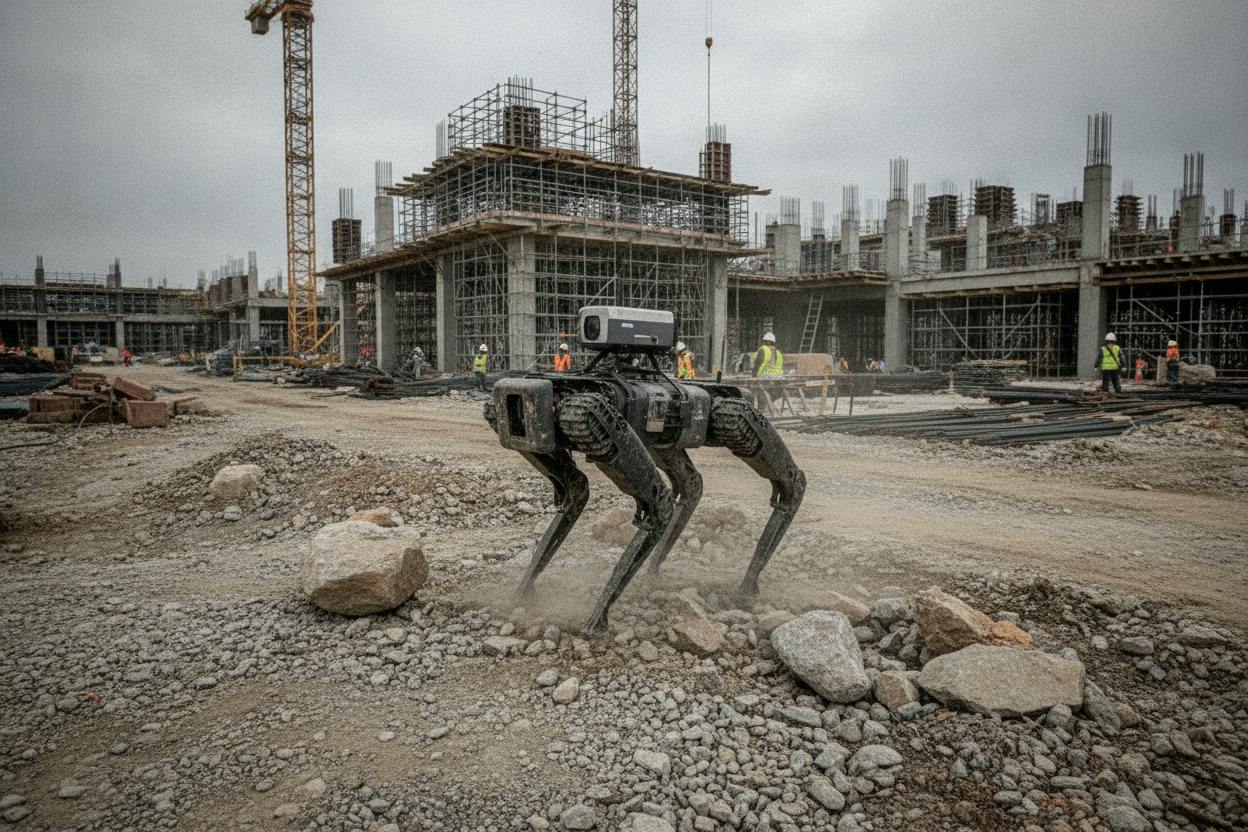
URobotics, a 2024 spinoff from KAIST's Urban Robotics Lab, has raised a $33.5 million Series A co-led by Kiwoom Investment and K2 Investment Partners, the Seoul-based startup said this week. Hyundai Motor Group's venture arm Zer01ne joined the round alongside Seoul Investment Partners, Schmidt, Nvestor, Aju IB Investment, TS Investment, Kingo Investment Partners, Ulmus Investment and Novosec Investment.
The valuation implied by the round is more than ten times what URobotics commanded at its $2.25 million seed round, a jump the company credits to signed customers and booked revenue in autonomous inspection work at construction and energy sites.
What the E-DONG-KIT actually does
URobotics doesn't build robot bodies. Its product, the E-DONG-KIT, is a modular, hardware-agnostic mobility kit that bolts onto humanoids, quadrupeds and other platforms, giving them the ability to judge rough terrain and move through it autonomously rather than following a pre-mapped path. That's a narrower, more defensible slice of the embodied-AI stack than trying to out-build Unitree or Boston Dynamics on hardware. URobotics is betting that mobility intelligence, not the chassis underneath it, is the harder problem to solve and the one operators will pay to outsource.
"Since the seed round, we've focused on solving customers' field problems and turning the value of our technology into actual contracts and revenue," the company's CEO said in announcing the round. That emphasis on paid deployments over demos is notable in a sector still dominated by splashy but unmonetized pilots.
Korea's robotics funding is accelerating
The round ranks around the 98th percentile of all-time Series A deals in South Korea's robotics-adjacent sectors by size, according to deal trackers, and follows a string of large Korean robotics raises this year. Humanoid startup Holiday Robotics closed a $130 million Series A in July, and HD Hyundai Robotics invested $10.9 million in sensor maker Aidin Robotics in September. Hyundai Motor Group's participation through Zer01ne ties URobotics into a carmaker ecosystem that has funneled money into humanoid and mobility robotics all year, echoing Hyundai's broader stake in Boston Dynamics.
For URobotics, the money is earmarked for scaling deployments beyond its current base in construction and energy-site inspection, where robots have to navigate uneven ground, scaffolding and shifting worksite layouts without a human operator walking them through it beforehand. That's a harder mobility problem than the flat warehouse floors most delivery and logistics robots operate on, and one where failure means a stalled or toppled robot rather than a missed delivery window.
If the kit proves itself across more robot platforms and industries, URobotics could end up supplying the mobility layer for multiple hardware makers at once rather than competing with any single one of them, a software-style business model layered on top of a hardware-heavy industry. That positioning also makes the company a useful bellwether: its revenue growth says as much about real-world demand for field robotics as it does about URobotics itself.