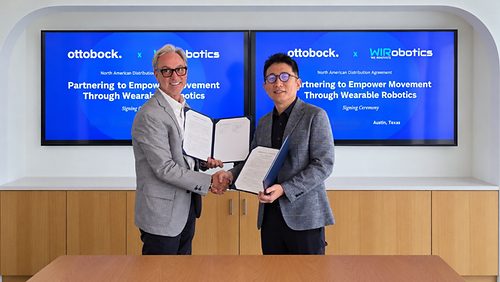
WIRobotics, a South Korean wearable-robotics maker, has signed a distribution agreement with Germany's Ottobock to sell its WIM S walking-assist robot in the United States and Canada. The companies announced the deal on November 16, 2026, roughly a month after signing it on October 15, according to PR Newswire.
What exactly is the WIM S, and who has been buying it?
WIM S is a wearable mobility robot designed to help people walk more easily in daily life, worn like a hip or leg brace rather than a full-body exoskeleton. It's now in its third year of commercialization and has passed 4,000 cumulative units sold across South Korea, Europe, China and Japan. North America is its newest market.
How will people actually buy it in the US and Canada?
Ottobock, a 100-plus-year-old German mobility-device company, will distribute WIM S through two channels: direct-to-consumer sales on Ottobock's own platform and WIRobotics USA's online store, plus in-person access at select orthotic and prosthetic clinics. The companies are also discussing bringing WIM Medi, a medical-grade version of the device, to the US once it clears regulatory review.
Why does this deal matter beyond one product line?
Wearable exoskeletons have struggled to move past pilot programs and into retail-style distribution, partly because most makers lack a channel into clinics and consumer medical-device retail at once. Ottobock's century of prosthetics and orthotics relationships gives WIRobotics a distribution network it couldn't build alone, while Ottobock gets a commercialized mobility robot instead of building one in-house. WIRobotics raised KRW 95 billion, about $68 million, in a Series B round in May 2026, giving it the balance sheet to support a new market launch.
What comes next?
WIRobotics USA, led by general manager Jacob Kim, will run day-to-day sales support in North America, while WIRobotics co-CEOs Younbaek Lee and Yongjae Kim continue product development in Korea. The next milestone to watch is whether WIM Medi clears US regulatory review, which would open the device to insurance-reimbursed clinical use rather than consumer wellness sales alone.