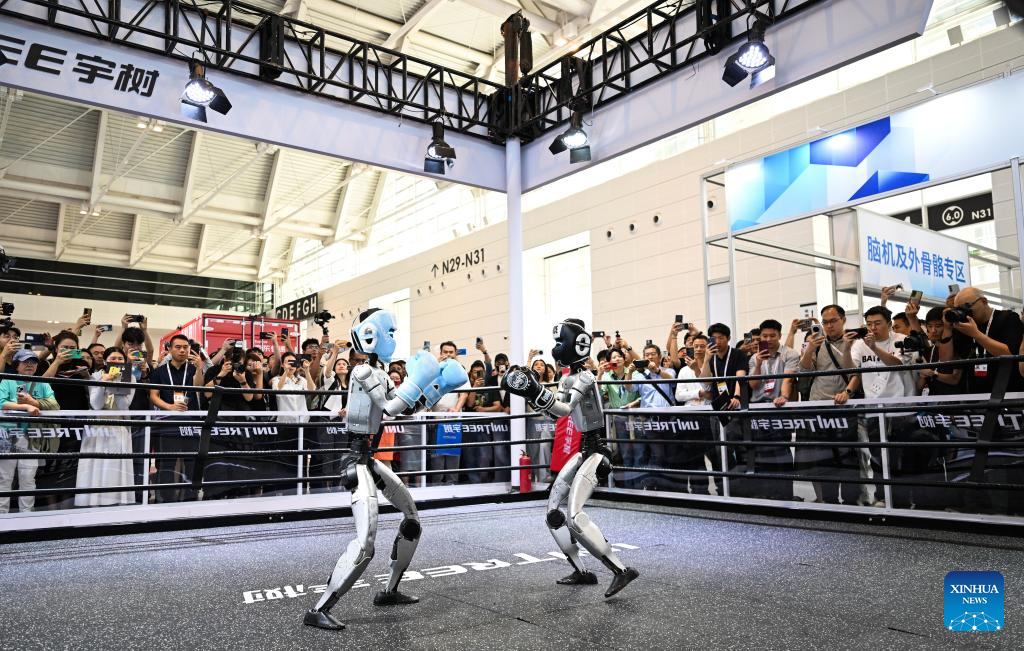
The World Intelligence Expo 2026 opened on May 28, 2026 in north China's Tianjin Municipality, framing the year as a coming-out moment for embodied AI. The four-day show, co-hosted by the Tianjin and Chongqing municipal governments, brought together more than 700 exhibitors across 130,000 square meters of floor space and is themed "Intelligence: Extensive Development Space, Sustainable Growth Driver."
A Dedicated Embodied AI Pavilion
For the first time, the expo carved out a standalone Embodied AI Pavilion, with more than 80 companies and nearly 150 complete robot models on display, according to organizers and Xinhua coverage. Unitree Robotics headlined the floor with humanoid robots demonstrating boxing routines and other live performances, alongside quadruped "robot dogs" showcasing load-bearing capability. Other live demonstrations included robots threading needles and playing electronic pianos, underscoring how rapidly the Chinese humanoid ecosystem has moved from prototypes to choreographed public showcases.
Seven Zones, AI Across the Stack
The expo's seven exhibition zones span embodied AI, core AI technologies, the low-altitude economy, commercial space exploration, intelligent connected vehicles, smart manufacturing and smart living. The event introduced a "Robot Town" concept designed to stage real-world deployments in manufacturing, retail, entertainment, elder care and home life. Organizers said more than 200 new products, technologies, achievements and research reports will be released during the show.
Beijing Doubles Down on "AI+"
Vice Minister of Industry and Information Technology Ke Jixin said the ministry will work with industry to advance the "AI+ manufacturing" initiative, strengthen innovation capabilities and improve the industrial environment. Liu Liehong, head of the National Data Administration, emphasized that high-quality datasets are both a technical resource and an innovation engine for advanced manufacturing, pointing to dataset programs in automobile manufacturing, shipbuilding, rail transit, non-ferrous metals and petrochemicals.
Why It Matters Globally
The Tianjin show comes as Chinese robotics firms increasingly anchor global humanoid coverage. Unitree's low-cost humanoid platforms have already been picked up internationally, including a recently announced Japan Airlines trial of the Unitree G1 at Tokyo's Haneda Airport, while Chinese startup Robotera recently raised $200 million from SF Group and other investors to scale humanoid production. The expo's embodied AI focus also dovetails with Hugging Face's open-source LeRobot push and other moves to commoditize humanoid hardware and software.
What to Watch
For Western robotics companies and investors, the Tianjin expo is one of the clearest signals yet of how aggressively Chinese policy, capital and industrial capacity are converging around embodied AI. With over 80 humanoid- and robotics-focused exhibitors, government-backed dataset initiatives and a steady drumbeat of public demos, 2026 is shaping up as a year where China seeks to lock in scale and unit economics in a category many had assumed would be defined by U.S. labs.
Reporting based on coverage from Xinhua, People's Daily Online, GlobeNewswire, and ichongqing.