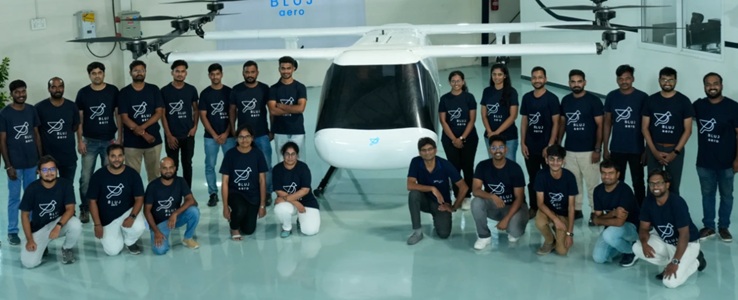
Hyderabad-based startup BluJ Aerospace on May 28 unveiled the Gen #2 prototype of its electric vertical take-off and landing (eVTOL) aircraft, the next step in a development program built on its Vertically Integrated Architecture for Next Generation Intelligent Aerial Systems (VANTIS) platform. The reveal was reported by Evertiq, citing local coverage from Businessline and The Hindu.
Gen #2 is now in active flight testing. It follows BluJ's earlier technology demonstrator and Gen #1, which the company describes as India's first public flight demonstration of a 500 kg-class eVTOL aircraft. The new prototype keeps the 500 kg maximum take-off weight envelope, runs purely on battery power and targets an active payload of more than 200 kg.
Lift-plus-cruise design built for scaling
The Gen #2 aircraft uses a lift-plus-cruise configuration, which separates vertical lift rotors from a forward-cruise propulsion system. The arrangement trades some hover efficiency for a simpler transition between vertical and horizontal flight, an approach that several global eVTOL programs have adopted as they move from prototypes to certification.
BluJ frames Gen #2 less as a single product than as a flying testbed for VANTIS, which it positions as a modular platform architecture rather than a one-off airframe. The company says VANTIS is designed to scale upward to larger VTOL aircraft, including a one-ton payload class targeted at heavy logistics and a hydrogen-electric long-range passenger variant.
What the founder is signaling
"The next major shift in aviation is the move from single product programmes to platform based architectures," BluJ Aerospace founder and chief executive Amar Sri Vatsavaya said in remarks reported by The Hindu. "Advanced Air Mobility will need adaptable architectures that scale across missions, payloads and customer use cases. That is the advantage VANTIS gives BluJ."
The framing matches a broader industry trend. Several international eVTOL developers are now positioning their platforms for cargo, regional passenger and even defense missions on shared structures and avionics. BluJ's bet is that India can host a credible, locally engineered entry into that race.
How it fits the global eVTOL race
The Gen #2 reveal lands amid a busy stretch for the global advanced air mobility sector. Earlier this week, the UAE's General Civil Aviation Authority moved Archer's Midnight eVTOL into its restricted type certificate program, while AutoFlight completed a mixed eVTOL formation flight as it kicked off V5000 certification work. Eve Air Mobility also wrapped its initial hover-test block and is now preparing for transition flights. Hermeus's Quarterhorse Mk 21 meanwhile showed how the high-speed end of aviation is moving in parallel.
What comes next
BluJ has not disclosed a public timeline for Gen #2 to complete its current flight-test campaign, nor has it announced certification plans with India's DGCA. The company's roadmap, however, hinges on whether VANTIS can credibly support the heavier cargo and passenger variants it advertises. The Gen #2 prototype is the first real-world test of that thesis.
For India's eVTOL ecosystem, the unveiling is notable because most public flight demonstrations of small electric aircraft to date have come from Chinese, European and US developers. A homegrown 500 kg-class prototype in active testing puts BluJ among a small group of Indian companies positioning themselves for the country's emerging urban and regional air mobility market.
Reporting based on coverage from Evertiq, Businessline and The Hindu.