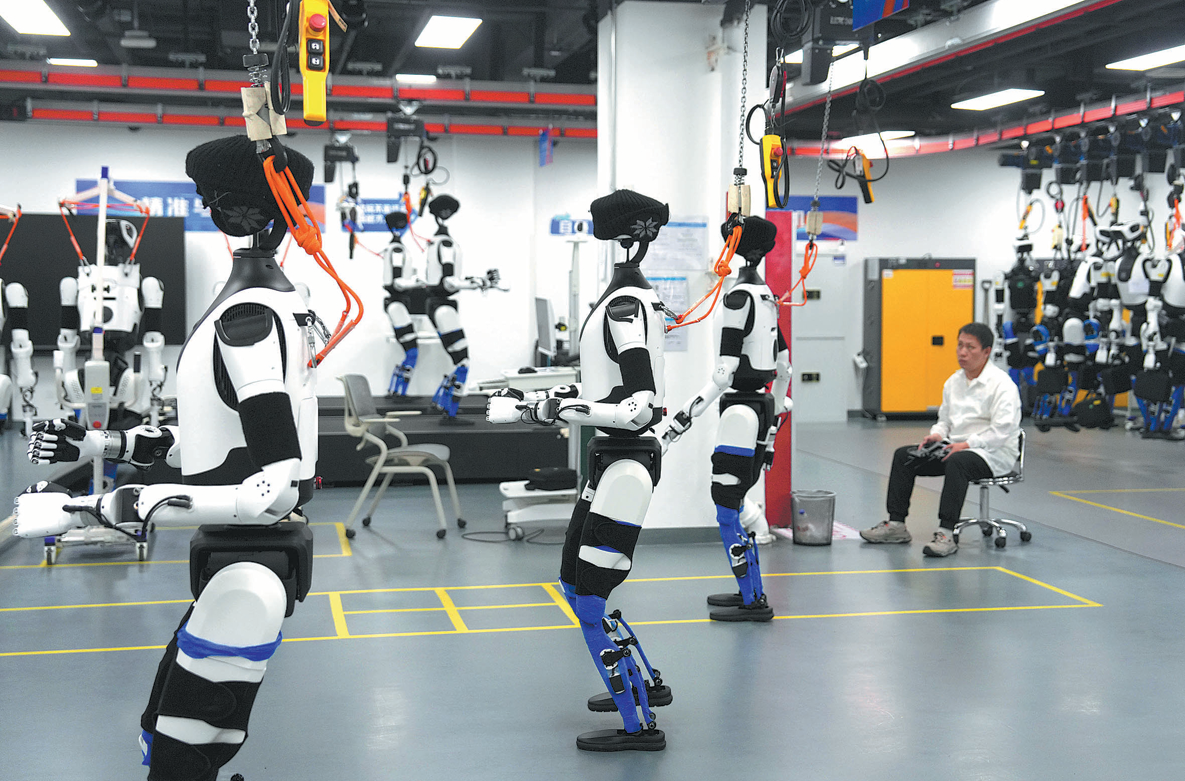
China's humanoid robot production will exceed 100,000 units in 2026, Ministry of Industry and Information Technology deputy director of science and technology Gan Xiaobin told a Tuesday press conference for the World Artificial Intelligence Conference (WAIC), reinforcing the national push to move humanoid robots from demo units to real workplaces.
The number and where it lands
Gan said China's evolving AI applications and ecosystem is powering the booming robot industry, with the penetration rate of AI applications at Chinese industrial enterprises "above designated size" surpassing 30 percent. He also flagged that the National AI Industry Investment Fund is stepping up operations to channel more social capital into humanoid robots and embodied AI, signaling continued state co-investment in the sector alongside private venture rounds like the recent $74 million pre-Series A into Zeroth.
MIIT and SASAC are pushing 'work mode'
The 100,000-unit target lines up with a nationwide implementation program the MIIT and the State-owned Assets Supervision and Administration Commission (SASAC) rolled out earlier this year to push key humanoid robot products into "regular deployment in a number of representative scenarios" by year end. That means factories, logistics centers, hospitals and emergency response — not just staged demos. It reinforces what Morgan Stanley called China's 2026 humanoid shipment forecast and puts pressure on Chinese platforms to hit real revenue rather than valuation multiples.

WAIC as the shop window
Many of the domestic innovations will be on display during the 2026 WAIC in Shanghai from July 17 to 20. Under the theme "AI partnership for a brighter future," the conference has attracted more than 1,100 exhibitors and expects over 3,000 exhibits, with more than 300 global debuts. Expect to see units from Unitree, Fourier Intelligence, UBTech, Zhiyuan (Agibot) and Booster Robotics — the last one just swept RoboCup 2026 titles with its T1 platform.
Why it matters
China producing 100,000 humanoid units in a single year would be a step change against the West's current pace. Figure, Apptronik, Agility Robotics and 1X together are on track to ship a few thousand units in 2026. Even if Chinese output skews toward lower-cost consumer companions like Zeroth's M1 and W1 rather than industrial workhorses, the sheer volume gives Chinese OEMs a data flywheel — millions of hours of real-world sensor data feeding physical AI foundation models — that Western rivals will struggle to match without similar deployment scale.
Reporting based on coverage from Xinhua via China Daily, TASS, SCMP and eWeek.