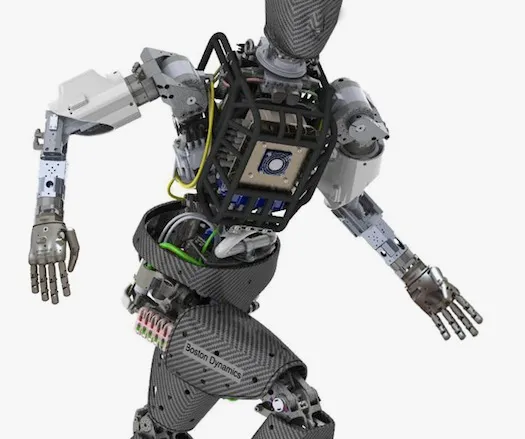

DARPA’s Microsystems Technology Office issued a Request for Information in late May 2026 titled “Materials for Physical Compute in Untethered Robotics,” asking researchers how sensing, computation and actuation could be moved out of a robot’s central processor and into the materials its body is made from. Responses were due May 27, with an invitation-only workshop tentatively scheduled for June or July.
Why DARPA Is Asking
Today’s untethered robots — humanoids, drones and quadrupeds — pay an enormous power and latency tax to push every sensor reading through a central GPU or NPU. DARPA argues that embedding signal processing, memory and feedback loops directly into soft polymers, metamaterials and structural composites could unlock a step change in autonomy duration, mass and reflex speed. The agency cites recent work in mechanical neural networks and stretchable transistors as proof points.
What Counts as Physical Compute
DARPA is interested in materials that can perform classification, filtering, regulation or actuation in response to physical inputs without a digital intermediary. Examples include shape-memory alloys with programmable response curves, ionic-conductor skins that act as distributed sensors, and origami-like mechanical metamaterials that act as control logic for grasping.
Industry Implications
The RFI lands as humanoid programs at 1X, Figure and Robotera race to lower the cost-per-hour of bipedal labor, where battery life is one of the most binding constraints. Materials-level compute could reduce both onboard power draw and the size of the control electronics inside a torso. DARPA expects strong responses from academic groups and from startups straddling soft robotics and advanced materials science.
Timeline
The agency framed the RFI as a precursor to a larger funding program, with formal solicitations expected later in 2026. Past DARPA materials programs, including the RSGS robotic servicing mission and earlier work on programmable matter, have taken multiple years to mature into deployable systems.
Reporting based on coverage from TechTimes, DARPA program announcements and ScienceDaily.