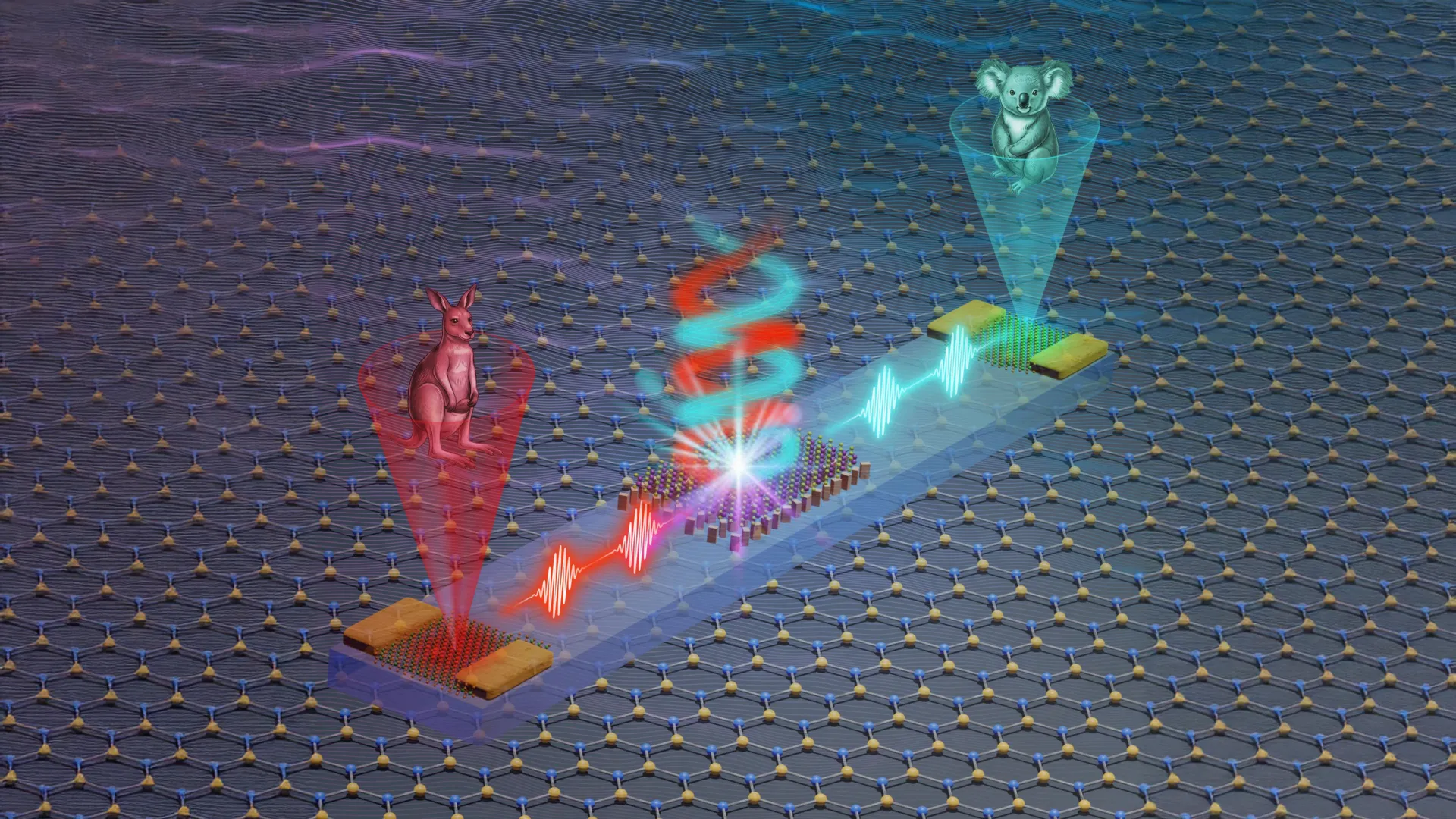
Researchers at Monash University in Melbourne have demonstrated a single chip that can generate, steer and read out information encoded in light using a quantum property called the "valley" degree of freedom. Published in Nature Photonics on June 2, 2026, the device is one of the most concrete advances yet in valleytronics, a field that could underpin faster, more efficient AI and quantum computing.
How Valleytronics Works
Valleytronics encodes information in the valley index of charge carriers in atomically thin two-dimensional materials, in addition to charge and spin. The Monash team uses nanoscale structures fabricated in 2D transition metal dichalcogenides to control the valley state of emitted photons, then routes those photons through on-chip waveguides to a detector — all in one integrated package.
Why It Matters For AI Compute
The advance is significant for two reasons. First, light-based interconnects can move data with far less energy per bit than electrical wires, a key constraint for next-generation AI training systems. Second, photonic integrated circuits that natively handle quantum properties of light could become a substrate for both faster classical AI accelerators and emerging quantum information processors. As leading chipmakers race to ship more memory-rich AI accelerators, photonic interconnects are increasingly viewed as a long-run answer to power and bandwidth limits.
From Lab To Foundry
The Monash chip was fabricated using techniques compatible with standard silicon photonics workflows, which the authors say is critical for moving valleytronics from lab demonstrations toward foundry-scale production. The team noted that integrating valleytronic devices with existing CMOS processes is one of the next major research milestones, and would unlock commercial co-packaging with GPUs and custom AI silicon.
Context Within Australian Research
The work was conducted by the ARC Centre of Excellence in Exciton Science and the Monash School of Physics and Astronomy, with funding from the Australian Research Council. It joins a growing body of silicon and photonics research aimed at materially reducing the energy cost of AI workloads.
Reporting based on coverage from ScienceDaily, Nature Photonics and Monash University.