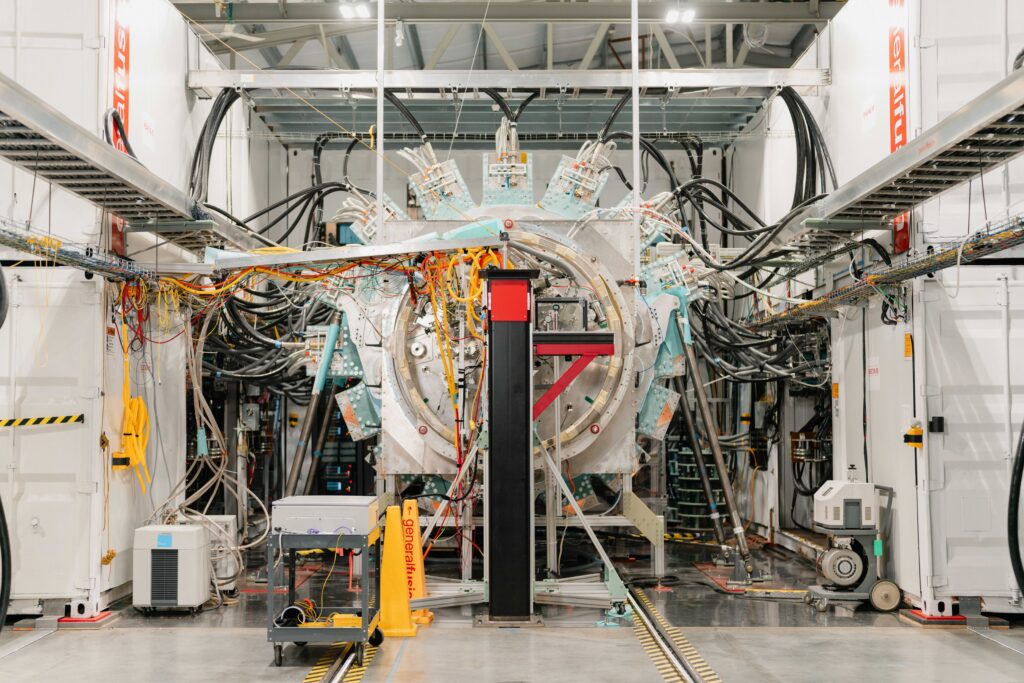
Canadian fusion company General Fusion says its Lawson Machine 26 (LM26) has heated hydrogen plasma to roughly 8.4 million degrees Celsius by mechanically squeezing it, a first-of-its-kind demonstration of compressional plasma heating and a key proof point for the company's Magnetized Target Fusion approach.
Squeezing Plasma Instead of Zapping It
Unlike laser-driven or purely magnetic approaches, Magnetized Target Fusion compresses a magnetized plasma with mechanical drivers, in LM26's case a lithium liner collapsed around the target. The 8.4-million-degree result, announced in late June and submitted for peer review, shows the plasma gaining temperature from compression itself, the mechanism a future commercial plant would rely on to reach fusion conditions. General Fusion says the campaign also validated its diagnostics partnership with General Atomics.
A Momentum Year for a 24-Year-Old Bet
Founded in 2002 and based in Richmond, British Columbia, General Fusion has spent two decades pursuing a mechanical route to fusion that avoids exotic lasers and enormous superconducting magnets. The company has ridden a wave of proof points in 2026, including top global rankings and steps toward public markets, as covered in our earlier report on General Fusion's investor conference push and SPAC path.
Fusion's Race to the Grid
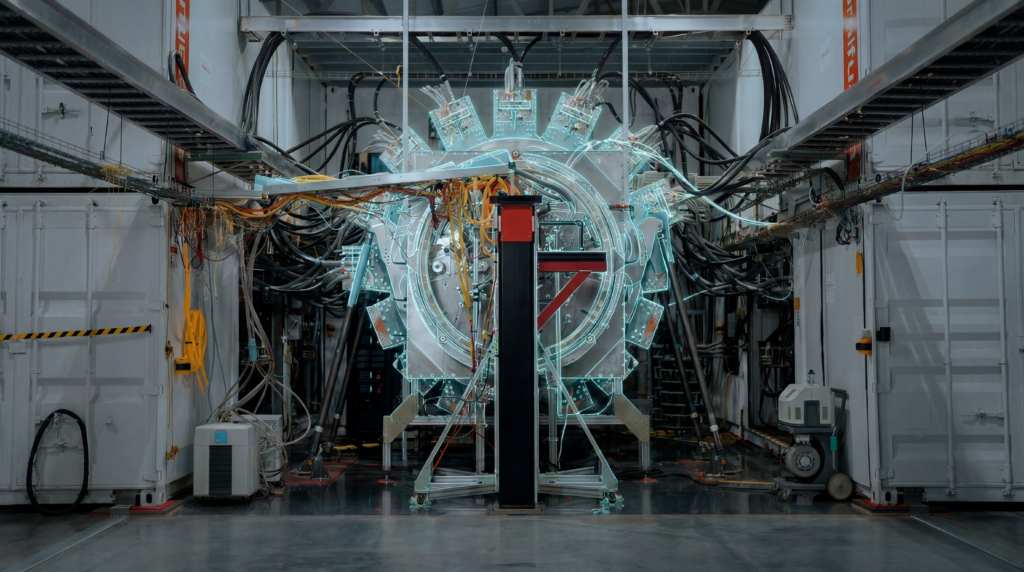
The milestone arrives as fusion and advanced fission compete for energy-hungry customers, particularly AI data centers. Investment is pouring into next-generation nuclear, from Applied Atomics licensing BWXT's mPower SMR design to the DOE's $400 million awards to TVA and Holtec, while data-center power deals reshape demand forecasts. General Fusion's next step is pushing LM26 toward higher compression ratios and, ultimately, scientific breakeven conditions.
Reporting based on announcements from General Fusion and newswire coverage.