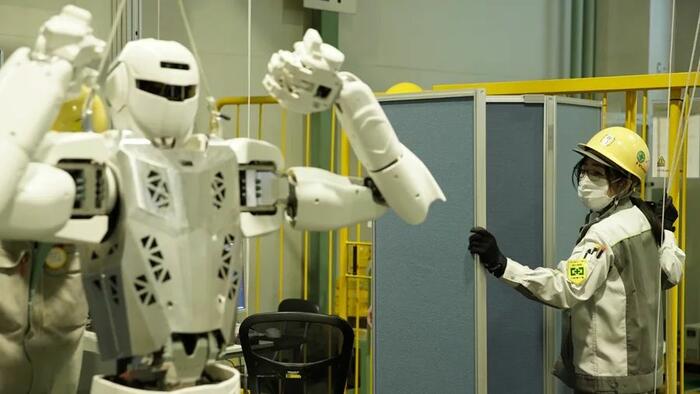
Japan's government released an updated national AI robotics strategy on July 1 that commits the country to building a sovereign, domestically developed AI model and deploying some 10 million AI-powered robots across the economy — a plan that treats physical AI as the backbone of the nation's industrial future.
Eighteen Fields, From Factories to Restaurants
Industry Minister Ryosei Akazawa said the plan aims to "vigorously promote social implementation across a total of 18 fields," with restaurants, food manufacturing and medicine among the newly added sectors. The strategy's central theme is physical AI — artificial intelligence applied in real-world environments — spanning self-driving vehicles, factory automation and humanoid robots designed for practical tasks. The robot deployment push forms part of Japan's multi-trillion-dollar technology and startup agenda, and lands just after South Korea announced its own record public-private AI investment pledge.
Playing to an Industrial Strength
Few countries bring Japan's manufacturing base to a robotics race. The country is home to industrial robotics giants FANUC, Yaskawa Electric and Kawasaki Heavy Industries, and produces roughly half of the world's industrial robots by volume. The new strategy seeks to convert that hardware dominance into leadership in AI-driven robotics, where Chinese and American firms have moved aggressively on foundation models and humanoid platforms.

Sovereign AI Meets Physical AI
Pairing a homegrown AI model with mass robot deployment mirrors moves elsewhere in Asia, and builds on momentum already visible in the country's private sector — from Japan Airlines' humanoid trials at Haneda to Toyota's large AMR deployments in Japanese plants and startup activity like Atom's seed round for a new species of humanoid robotics. The strategy makes explicit that data and AI processing for critical robot fleets should remain within domestic borders.
Execution will decide whether the 10-million-robot goal is industrial policy or aspiration, but the direction is unambiguous: Japan intends to be the place where AI gets a body.
Reporting based on coverage from The Japan Times.