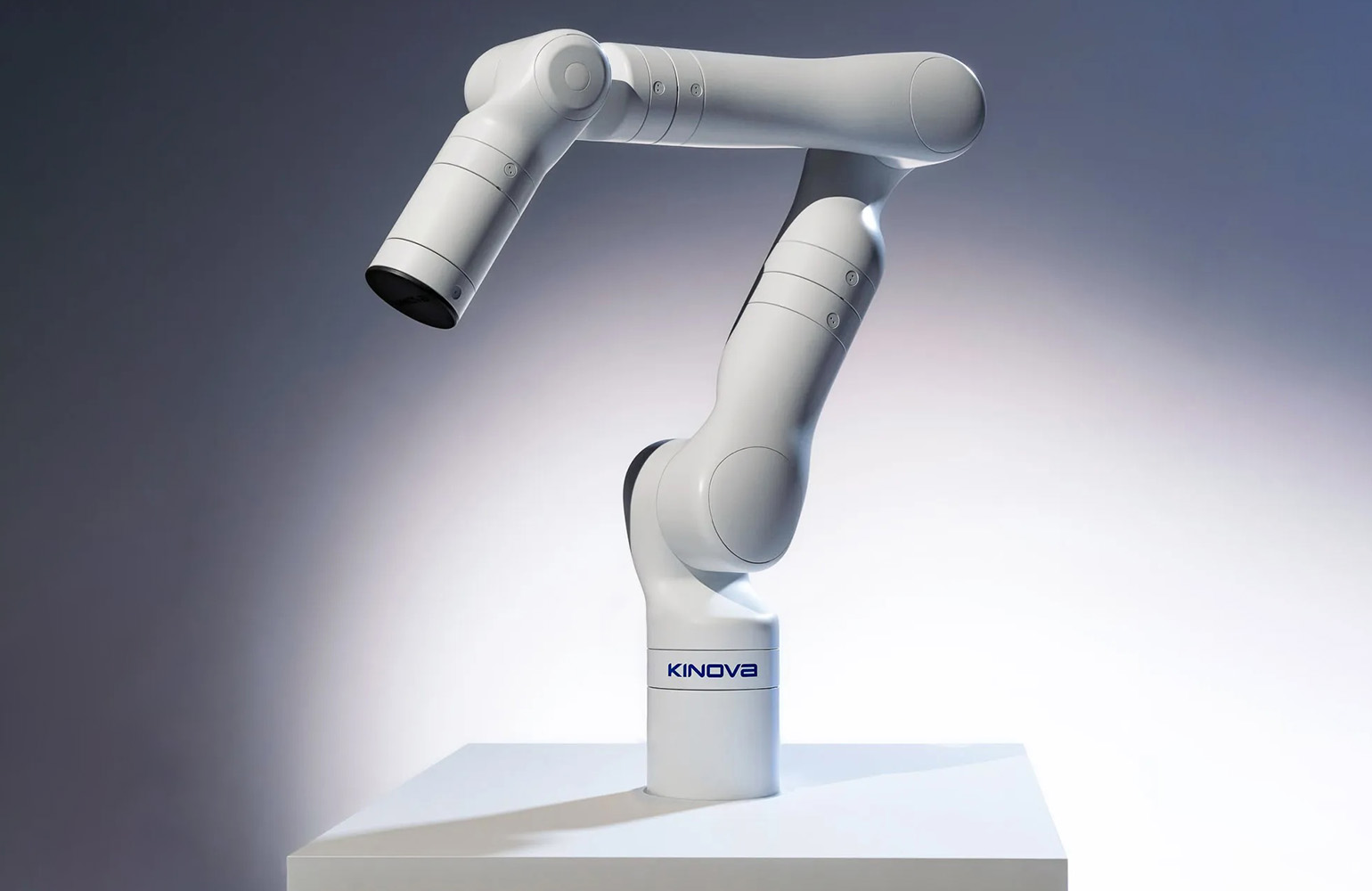
Canadian robotics developer Kinova has marked its 20th anniversary by launching KIMA, a medical robotic arm purpose-built for clinical environments. The company says KIMA can support practitioners across a broad spectrum of procedures, from endoscopy and bronchoscopy to complex surgical interventions.
Designed from the ground up for clinical use
Unlike many medical robots adapted from industrial hardware, Kinova says it engineered KIMA specifically for the operating room. The arm carries a 3 kg (6.6 lb) payload in a lightweight frame under 13 kg (28.6 lb), eliminating bulky control boxes so it can fit into space-constrained ORs alongside other devices and equipment.
Safety and open integration at the core
KIMA natively integrates IEC 62304 Class C software and ISO 14971 safety standards. Every joint includes redundant torque sensors and advanced monitoring designed for medical environments. An open architecture built on EtherCAT communication and a controller-less control library enables direct control and easier integration into existing medical platforms, while instrument drives with power and passthrough I/O simplify the addition of surgical instruments.
A growing surgical robotics field
“KIMA represents a shift in how medical robotics should be built,” said François Boucher, vice president of strategic growth at Kinova. The modular platform is backed by technology partners including QNX, RTI, MedAcuity, MPE and Acontis, which Kinova says help startups and global medtech leaders accelerate development. The launch lands as physical AI pushes deeper into healthcare, echoing moves such as NVIDIA's GR00T surgical robot foundation model, Distalmotion's Dexter FDA clearance and the Psyonic-ABB dexterity partnership.
Reporting based on coverage from The Robot Report and Kinova.