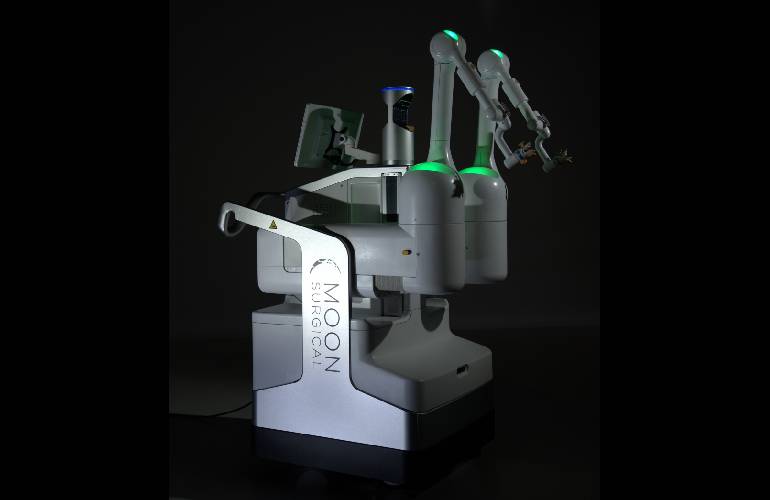
Moon Surgical has transformed Maestro, its accessible robotic surgical assistant, into a multi-model Physical AI platform with the release of Software Version 2.7, extending coordinated automation across the entire surgical workflow from pre-operative setup through post-procedure administration.
From a single AI capability to a coordinated platform
Announced from Paris and San Francisco, Version 2.7 expands Maestro beyond ScoPilot, its first intraoperative AI assistant, into a platform hosting three coordinated, AI-driven capabilities. Maestro now targets setup automation, staff alerting and coordination, dynamic scheduling, and the automation of case reporting and billing. The update is aimed squarely at high-throughput settings such as ambulatory surgery centers, where predictability and resource management matter as much as in-procedure precision.
Built on an NVIDIA-powered edge-to-cloud architecture
Maestro pairs on-device computing using NVIDIA Holoscan and NVIDIA IGX with centralized cloud AI, completing an edge-to-cloud design that the company says unlocks fleet-wide intelligence. ScoPilot remains the first AI application to run intraoperatively on a commercially available surgical robotic platform, and active 5G and Wi-Fi connectivity feeds Maestro Insights, the cloud analytics layer that surfaces procedural metrics and automates administrative tasks across an entire installed base.

Scaling proven clinical use
Designed as an accessible, enhanced version of traditional laparoscopy, Maestro acts as a robotic assistant that augments the precision and control of minimally invasive surgery while slotting into existing clinical workflows. The system has now supported more than 2,300 procedures across a range of specialties and indications. By layering automation onto that footprint, Moon Surgical positions Maestro as the digital backbone of the surgical center rather than a standalone tool.
The launch underscores how physical AI is moving deeper into the operating room, echoing broader momentum in surgical robotics and medical foundation models. It follows work such as NVIDIA's GR00T surgical robot foundation model, the rise of imaging-focused tools like SquareMind's SWAN dermoscopy robot, and AI diagnostics advances including Aidoc's FDA breakthrough radiology system.
Reporting based on coverage from Moon Surgical (PR Newswire) and MassDevice.