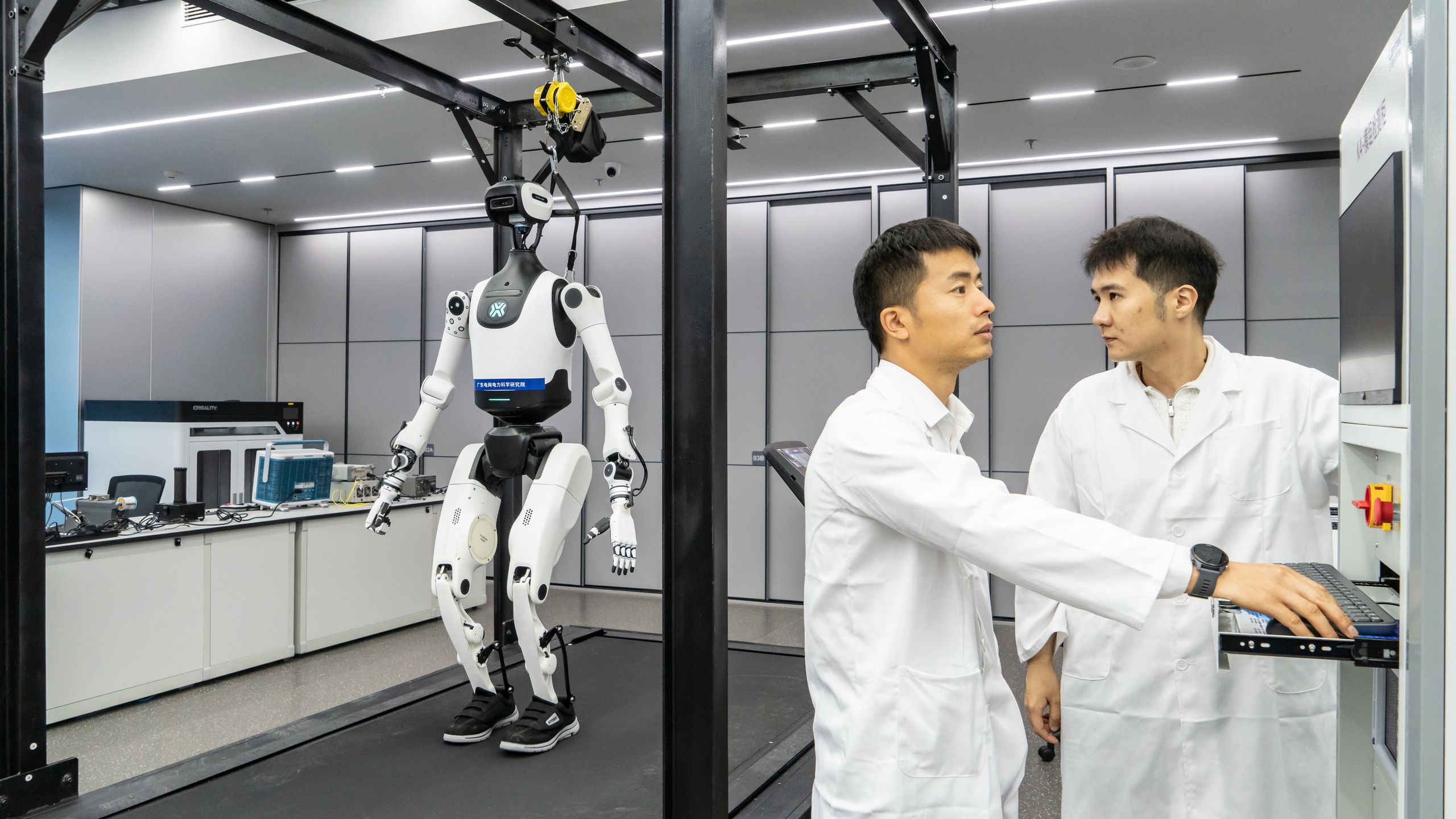
The State Grid Corporation of China — the world's largest utility — plans to procure roughly 8,500 embodied-AI robots in 2026, a 6.8-billion-yuan (about $1 billion) order that industry analysts are calling the single largest humanoid-and-quadruped purchase on record. The mix reveals the shape of real, non-demo deployment: 500 humanoids, 3,000 dual-arm robots and 5,000 four-legged quadrupeds heading into substations, ultra-high-voltage lines and mountain-terrain patrols.
How the 8,500 robots break down
State Grid's tender is stratified by task. The 5,000 quadruped units will handle routine patrols — substation walk-throughs, transmission-line inspections and access to remote mountainous terrain where human crews face the highest risk. The 3,000 dual-arm platforms are aimed at high-precision maintenance work on live-grid equipment, while the 500 humanoids will pick up the tasks that require gait, manipulation and human-shaped tool use in the same shift. Analysts at Morgan Stanley have separately doubled their China humanoid shipment forecast to 50,000 units for 2026 in response to procurement orders of this scale.
A ten-billion-yuan sector, not a headline
When similar plans from China Southern Power Grid and other state utilities are added, industry insiders expect total 2026 investment in embodied intelligence in the Chinese power sector to top 10 billion yuan. That reframes the humanoid conversation. The market debate has been dominated by whether the first million dollars of a humanoid contract will come from an automaker or a logistics firm. It looks likely to come, at scale, from the grid — and to include quadrupeds and dual-arm platforms in the same order.
Deployment feeds a broader Chinese buildout
The procurement lands alongside Japan's 10-million-robot plan and Beijing's separate MIIT push to move 10,000 humanoids into commercial roles this year. Companies best positioned to bid include quadruped specialists like Unitree, DEEP Robotics and Deep Robotics, and humanoid makers UBTECH, Robotera and Fourier Intelligence. Whichever suppliers win, the takeaway for global operators is the mix: the world's most consequential embodied-AI order this year is not a pure-humanoid contract — it is a fleet order for a specific set of infrastructure tasks.
Reporting based on coverage from South China Morning Post, TechRadar and Interesting Engineering.