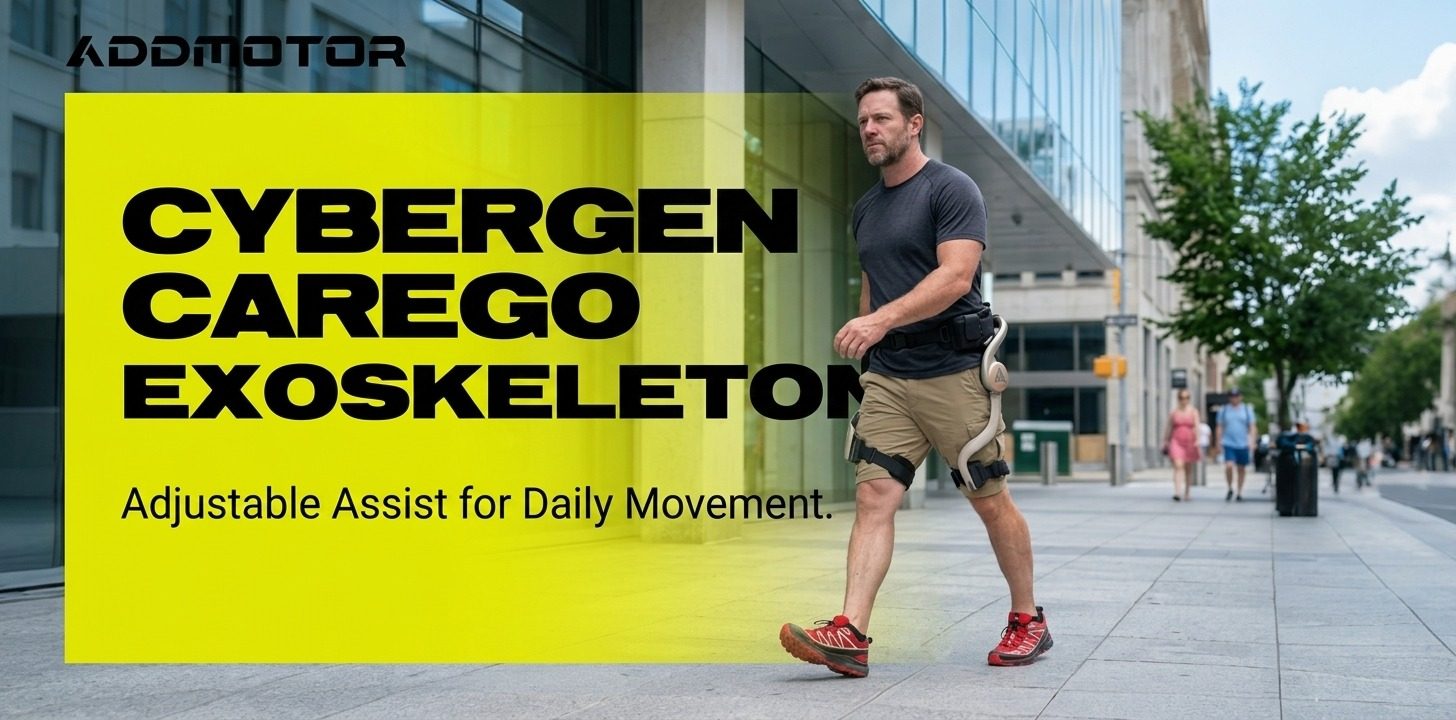
Addmotor Tech Corporation has commercially launched its Cybergen exoskeleton series across the United States, Canada and Australia, pricing two powered hip units at $1,099 and $1,299, the company announced in a press release published November 27. The Cadens, aimed at runners and hikers, and the Carego, built for everyday walking, each weigh 2.0 kg excluding batteries and deliver 40 N·m of torque from dual 1,000W motors.
Both units run on Addmotor's closed-loop AI motion engine, which reads stride, torque and terrain through onboard inertial sensors and gyroscopes to adjust assistance in real time. Dual 3,000 mAh swappable battery packs give each device up to 15 miles or five to six hours of runtime. Co-founder Winkey Li said the company packed "high-performance torque into a 2.0-kg frame, priced under $1,300," after years of exoskeletons being "too heavy and expensive for everyday use."
Why the Price Point Changes the Market
Medical-grade and industrial exoskeletons have historically carried price tags from several thousand to tens of thousands of dollars, restricting them to rehabilitation clinics, warehouses and construction sites with dedicated procurement budgets. Addmotor's sub-$1,300 pricing, paired with direct e-commerce distribution rather than enterprise sales, moves wearable robotics into the same purchasing category as premium e-bikes or fitness equipment.
That shift matters because it tests whether exoskeleton demand exists outside institutional buyers. Addmotor is targeting two distinct consumer segments: the Cadens for athletic use, with a fitness mode that reverses motor actuation for resistance training, and the Carego for the "Silver Economy" — older adults needing walking assistance — with four selectable modes including dedicated left-leg and right-leg assist. If the segment proves durable, it validates a direct-to-consumer path that medical device makers have largely avoided due to regulatory and liability concerns.
Competitive Pressure From Both Directions
Addmotor is not alone in chasing the sub-$1,500 exoskeleton. Chinese players like EULON have scaled past 30,000 units shipped, and Lenovo's Lecoo unit has priced a lightweight walking exoskeleton near $980 in China, suggesting the category's center of gravity is shifting toward consumer price points globally, not just in North America.
The trade-off is capability. At 1,000W peak output and a 184-degree articulation range, the Cadens and Carego are far less powerful than industrial exosuits from companies like German Bionic or Ottobock, which are built for repetitive heavy lifting under OSHA-relevant safety standards. Addmotor's devices are explicitly positioned for mobility assistance and recreational use, not workplace load-bearing — a narrower claim that avoids the certification burden heavier exosuits carry, but also caps their addressable market to consumers rather than employers.
Addmotor, founded in 2011 as an electric mobility manufacturer, is betting its existing direct-to-consumer infrastructure for e-bikes and trikes translates cleanly to wearable robotics. Whether that bet pays off will depend on whether Cybergen's software-driven assistance earns trust from buyers accustomed to purchasing exoskeletons as medical devices rather than consumer electronics.