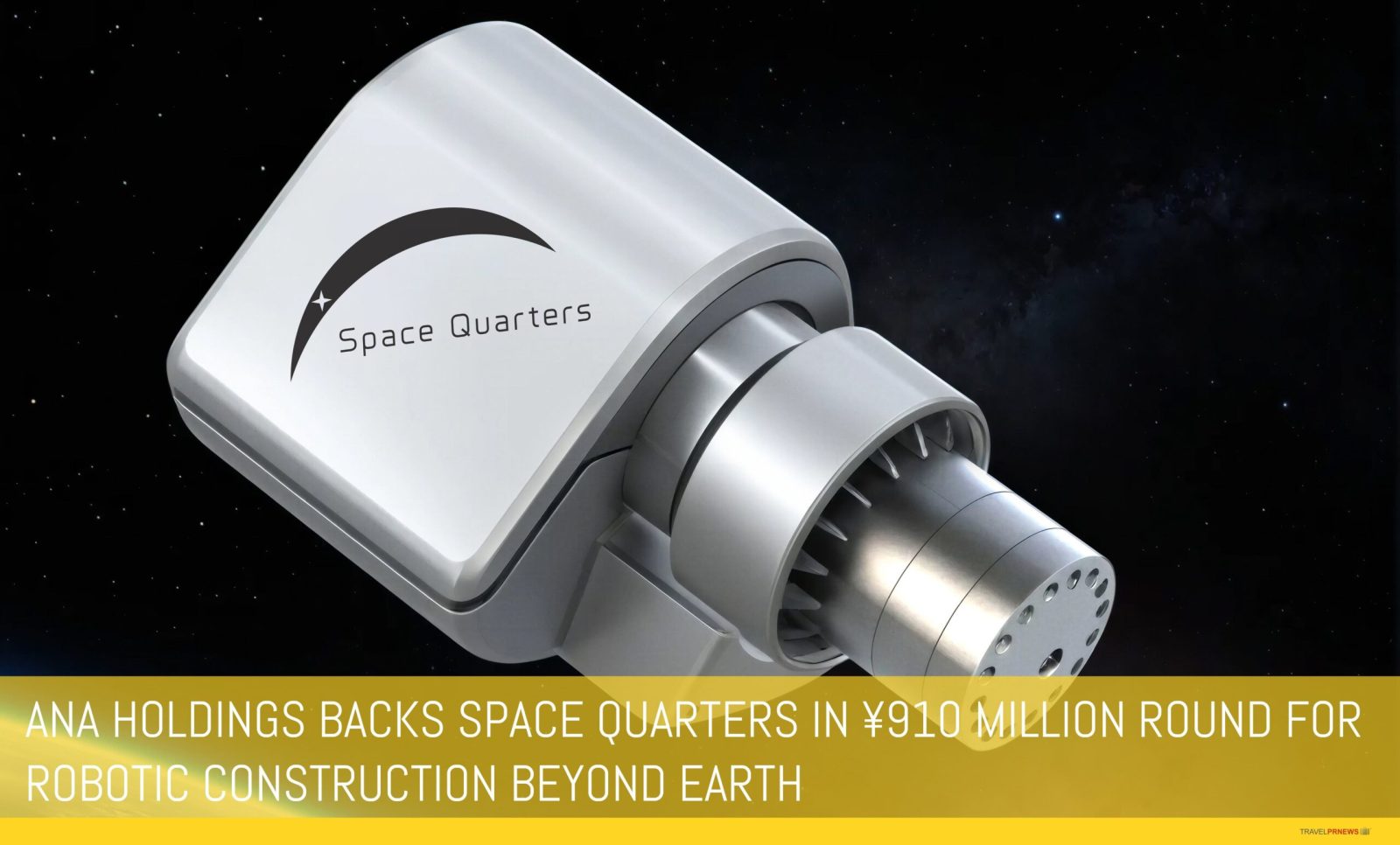
ANA Holdings, the parent company of All Nippon Airways, said on November 13, 2026, that it has invested in Space Quarters, a Tokyo-based robotics startup founded in June 2022, through its ANA Future Frontier Fund. The investment is part of a ¥910 million (about $5.7 million) pre-Series A round led by Global Brain's Flagship Fund IX, pushing Space Quarters' cumulative funding to ¥1.82 billion (roughly $11.6 million).
What does Space Quarters' DAIQ system actually do?
DAIQ is Space Quarters' answer to a basic problem in space construction: rockets have fixed fairing sizes, so you can't launch a fully assembled large structure. Instead of trying to, the company sends compact, unassembled components into orbit and uses three purpose-built robots to put them together on site. Tree retrieves components from storage, Ant transports and positions them, and Spider joins and welds them into place.
The pitch is that this approach lets structures scale beyond what any single rocket fairing could carry, since the limiting factor becomes assembly capability rather than launch volume.
Why would an airline holding company invest in space construction robots?
ANA set up the Future Frontier Fund with Global Brain in April 2024 with an ¥8 billion commitment over a 10-year term, aimed at backing aerospace and space ventures as the airline group looks past its core flight business. Space Quarters fits a pattern among Japanese conglomerates placing early bets on in-space infrastructure, where launch costs falling over the past decade have made orbital construction a more plausible commercial category than it was ten years ago.
The fund's other new investor in this round, Canon Marketing Japan's MIRAI Fund, points to similar interest from Japan's broader industrial base, not just aerospace specialists.
How far along is the technology, really?
Space Quarters has already run physical tests rather than just simulations. In March 2026, the company completed welding experiments during parabolic aircraft flight, simulating both zero gravity and lunar gravity conditions. An earlier ground-based test validated the assembly and welding sequence using a full DAIQ model on Earth.
The company's public roadmap calls for a 2028 demonstration on the exterior of the International Space Station's Kibo module, Japan's ISS segment, followed by a full orbital construction demonstration targeted for 2029 and a commercialization goal set for 2031. That is a tight but not unusual timeline for a hardware startup working toward orbital deployment, and each step, aircraft test, ground test, ISS exterior demo, orbital demo, adds a layer of real-world validation before the company asks a customer to trust it with an actual structure.
Who else is working on in-space assembly?
Space Quarters isn't alone in betting that orbital assembly beats launching pre-built structures. US-based Redwire Space has pursued in-space manufacturing and robotic assembly through programs like Archinaut, and satellite servicing companies such as Astroscale, also Japan-based, have proven that robotic systems can operate reliably on orbit, even if their focus is debris removal and life extension rather than construction.
What differentiates Space Quarters is the three-robot division of labor and its explicit plan to scale from a single ISS exterior demo to structures the company says could eventually extend to lunar surface construction. Whether that holds up past 2029 depends on how the Kibo demonstration goes, and on whether more capital follows this pre-Series A round.