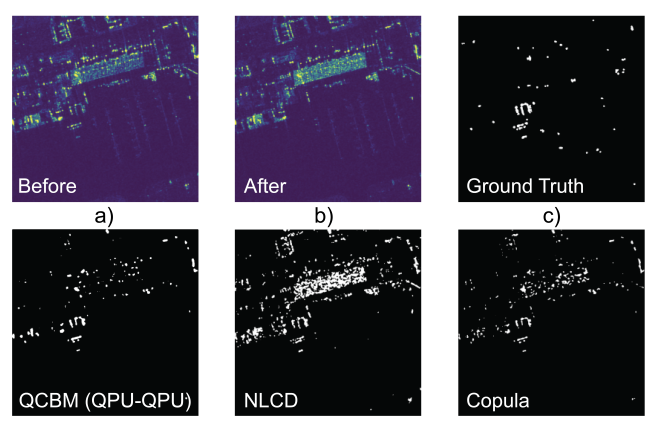
IonQ has published research showing that quantum machine-learning models running on its trapped-ion hardware can outperform classical baselines when detecting changes in high-resolution satellite synthetic aperture radar (SAR) imagery — a first-of-its-kind demonstration that couples IonQ's newly acquired Capella Space constellation with its production Quantum Circuit Born Machine (QCBM).
Real satellite data, real quantum hardware
The study, released on 25 September 2026 and analyzed by The Quantum Insider, evaluated a QCBM trained to spot meaningful pixel-level changes between SAR acquisitions collected at different times. IonQ researchers tested three configurations — classical models, a quantum simulator, and live inference on an IonQ trapped-ion QPU — against two operational SAR datasets: an X-band Stripmap amplitude pair at 1.2-metre resolution covering Marine Corps Air Station Miramar in San Diego, and interferometric coherence maps of Réunion Island's Piton de la Fournaise volcano eruption earlier in 2026.
Where quantum wins
The QCBM matched classical baselines on approximately Gaussian pixel distributions but pulled ahead when data was sparse or "strongly skewed" — the non-Gaussian statistics that dominate real defense-grade SAR chips. On those slices the quantum approach delivered higher F1 scores, translating into fewer missed changes and fewer false alarms during the automated triage step that human analysts rely on.
"Quantum outperformed classical methods, and benefitted the overall workflow in situations where image data was sparse," IonQ's team wrote in the accompanying disclosure.
.jpg)
Why Capella matters
IonQ closed its acquisition of Capella Space in July 2025, folding an operational SAR constellation into what is otherwise a pure-play quantum computing company. This week's paper is the clearest signal yet of how the two halves fit together: Capella supplies the primary data pipeline, IonQ supplies the compute, and defense and intelligence customers get a quantum-classical hybrid analytics stack aimed squarely at earth observation. It also plays into IonQ's broader push toward bringing Superion 256 systems into the NVIDIA quantum research center and its recently disclosed Sandia national-security MoU.
Roadmap and next steps
The QCBM demonstration was run on IonQ's current-generation trapped-ion processor rather than the coming Superion 256 electronic-control system, meaning the same workflow should scale as IonQ brings larger, lower-error machines online later in 2026 and into 2027. Government customers watching the space are focused on whether quantum change detection can be made routine enough for the tempo of live intelligence operations rather than one-off research showcases.
Reporting based on coverage from The Quantum Insider and IonQ's official announcement.