Anthropic on September 4 shared what it calls the first complete, computer-checked proof of Fermat's Last Theorem, produced largely autonomously by a swarm of Claude agents in the Lean proof assistant over 11 days. The run generated 13 million lines of Lean code and 30,300 intermediate theorems (29,500 of them used in the final proof), and it consumed roughly six billion output tokens on an internal research model that Anthropic says is roughly comparable to Claude Fable 5.1.
Why the result matters
Fermat's Last Theorem — the 1637 conjecture that an + bn = cn has no positive integer solutions for n greater than 2 — was proved by Andrew Wiles and Richard Taylor in 1995 in a 129-page write-up that took months to verify by hand. Kevin Buzzard's Imperial College team has been trying to formalize that proof in Lean since 2024, working from an 86-page blueprint and estimating the effort in years. Claude's run compressed the initial phase of that community project into under two weeks.
How the Claude agents worked
Anthropic's Tianyi Peng, whose Columbia group builds tools for AI formalization, coordinated the effort on Prove2Me — an open collaborative platform he designed for scaling math formalization. Prove2Me maintained a directed-acyclic graph of theorem statements so dozens of Claude agents could pick which proofs to attempt next in parallel, separated theorem statements from proofs into different files to speed up Lean compilation, and kept a natural-language index of every statement so agents could search and reuse existing lemmas. Human input was limited to occasional high-level nudges from Peng — for example, "Jacobian as a scheme sounds high priority."
Independent review
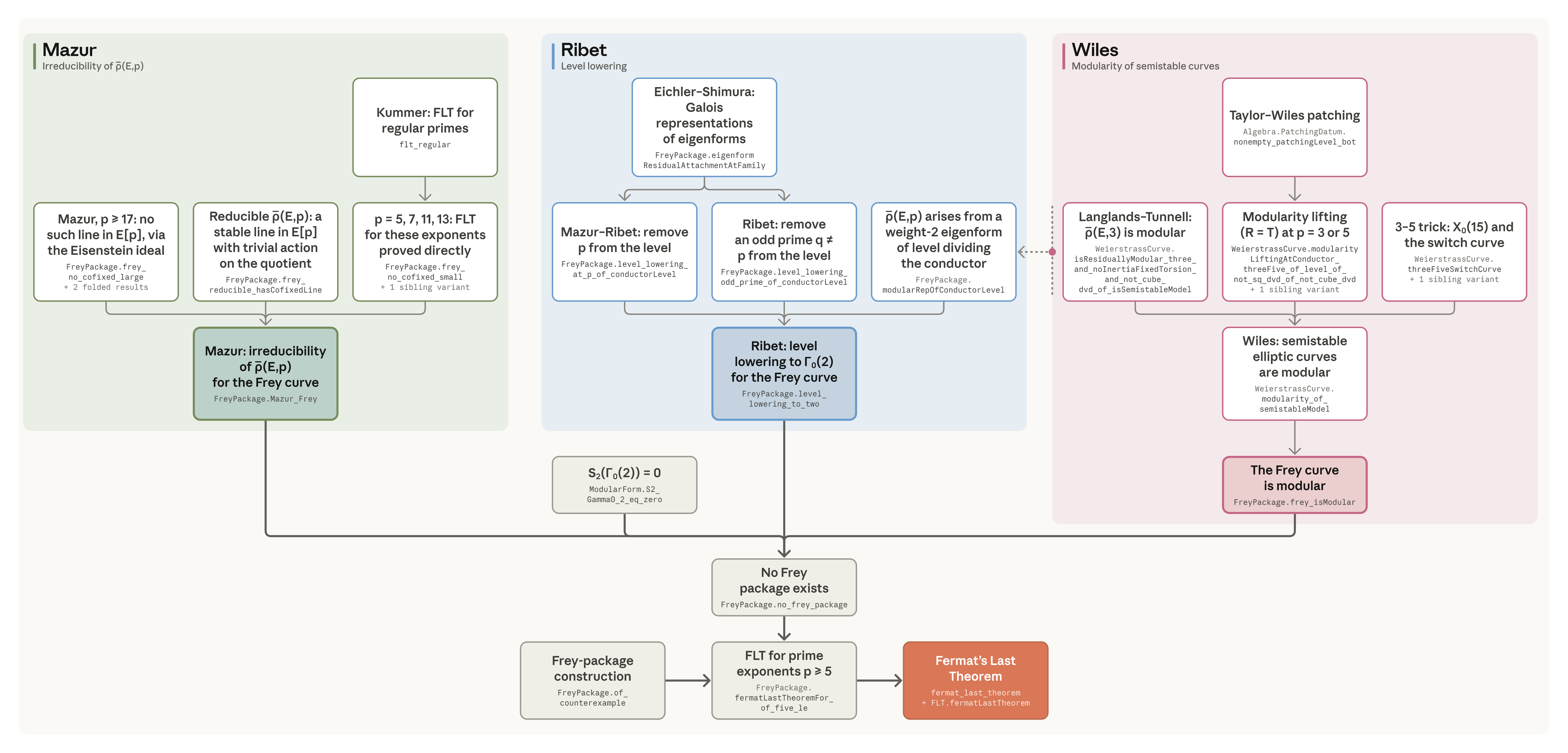
Buzzard reviewed the finished proof, which follows the simplified Wiles route by Darmon, Diamond and Taylor. "This extraordinary autoformalization achievement, which Anthropic researchers say only took 11 days, proves Fermat's Last Theorem with no assumptions other than the axioms of mathematics," Buzzard said. Lean verified the result using only its three standard axioms, and Anthropic's comparator tool confirmed that the theorem statement matches Mathlib's own statement of FLT. The full proof — over five times the size of Mathlib itself — is on GitHub.
What it says about AI-run mathematics
Unlike Anthropic's earlier Claude Fable 5.1 and Mythos 5.1 release, this is not new mathematics but new verification. The company argues that if formalization at this scale is now this cheap, it becomes practical to check the entire modern mathematical literature, root out latent errors, and — crucially — verify LLM-generated math without spending months of human referee time. Anthropic separately reported that a three-person team using consumer Claude Max plans formalized Vinogradov's Three Primes Theorem on Prove2Me in three days, arguing that collaborative formalization of major results is now within reach of individual researchers rather than just industrial-scale AI labs. The company is expanding its support for external mathematicians and pointed to its earlier Model Hardware Standard release as another rail for wiring Claude into rigorous scientific workflows.
Reporting based on coverage from Anthropic, AI Weekly and the Prove2Me project.