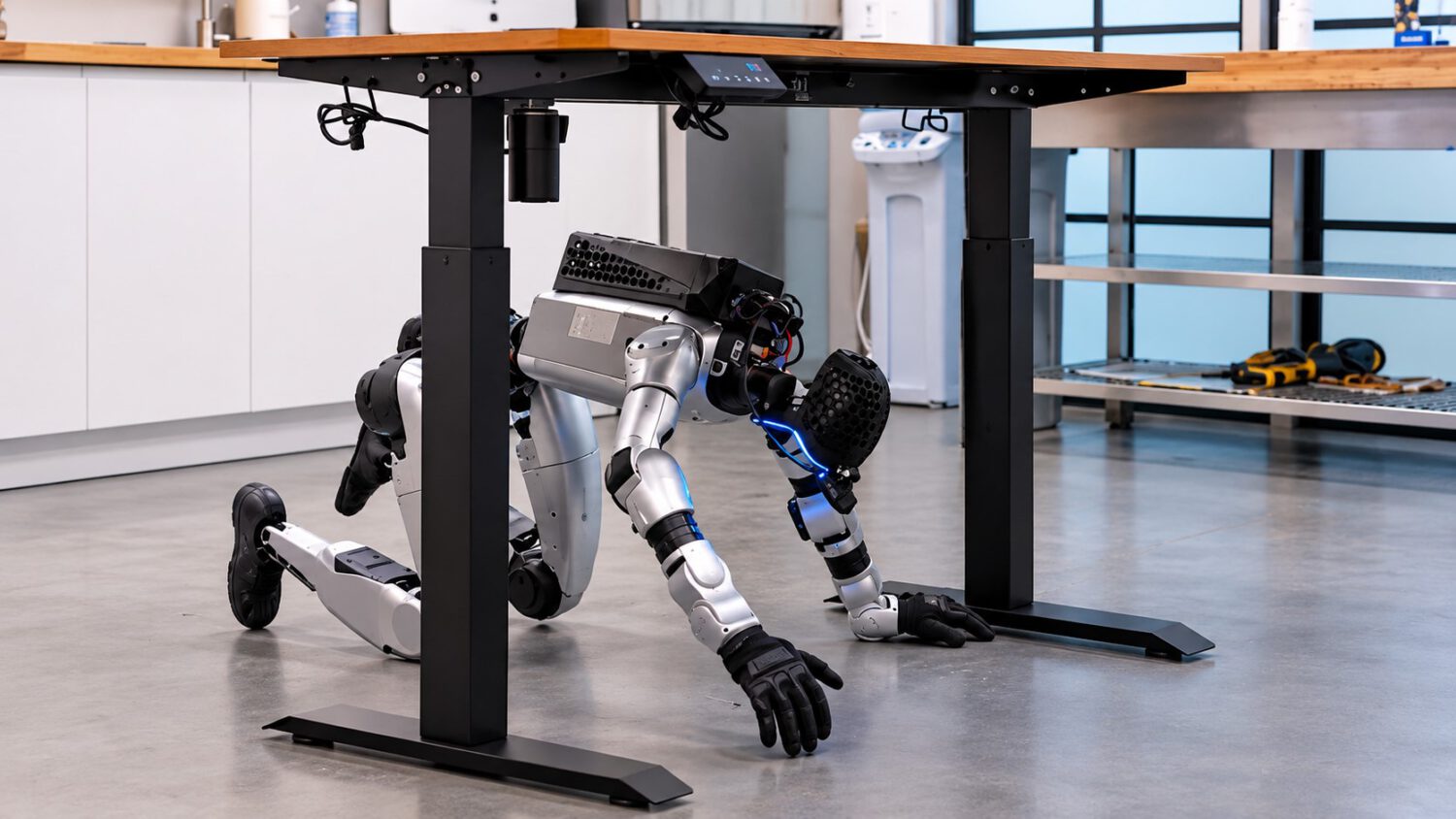
Strap a Mac mini to a humanoid robot's back, point it at a doorway it has never seen, and ask it to walk to a couch three rooms away. Apple researchers ran that kind of test 360 times across six unfamiliar real-world spaces, and the robot got it right 91% of the time, according to a paper the company posted to arXiv on November 4.
The system is called HALO, short for "Humanoid Autonomy, Learned in Simulation, running Onboard." The hardware is a Unitree G1 fitted with a head-mounted camera and a rear enclosure housing a Mac mini M4 Pro with 64GB of memory, running Alibaba's Qwen3.5-2B model entirely offline. There is no cloud connection and no teleoperator during the test runs.
Simulation instead of teleoperation
The bet behind HALO is that humanoid robots do not need armies of human teleoperators recording pick-and-place demonstrations. Apple's research team, whose authors include Siyuan Hu, Abulikemu Abuduweili and Vladlen Koltun, generated roughly 300 hours of synthetic training data across 1,000 procedurally generated virtual homes. The robot never set foot in a real house before its evaluation.
Once deployed, HALO had to sit, crouch under tables, navigate around furniture, pass through doorways and manipulate boxes, then chain several of those skills into longer sequences. Individual skills held up well: crouching under tables succeeded 100% of the time, sitting hit 85%. Multi-step chains were harder, averaging around 70% success, with one complex sequence succeeding only half the time.
Architecturally, HALO runs three layers: a language-based task orchestrator, a vision-motion generator that pairs Qwen3.5-2B encoding with diffusion-transformer decoding, and a low-level motor controller tracking the output. Apple has open-sourced the data generation, training and deployment code alongside the paper.
Why a research paper matters to the robot industry
Apple has not announced a consumer or commercial robot, and HALO remains a research project rather than a product. But the publication lands in the middle of an industry argument over how humanoid robots should learn: through recorded human teleoperation, as Tesla's Optimus and Figure's robots largely rely on, or through large-scale simulation, the path Nvidia has pushed with its Isaac and GR00T platforms.
A 91% success rate on single tasks in six rooms the system had never mapped is a meaningful data point for the simulation camp, even if the drop-off on multi-step chains shows the limits of zero-shot transfer from synthetic data. Running the entire control stack on a Mac mini, rather than a remote GPU cluster, also speaks to Apple's long-standing interest in on-device compute — the same instinct behind the iPhone's local neural engine, now applied to a 20-kilogram humanoid.
The choice of a Unitree G1, the roughly $16,000 Chinese-made robot that has become a default research platform for labs without the budget or patience to build their own hardware, also underscores how much of humanoid research now runs on commodity bodies while the differentiation moves into software. For a company watching Nvidia, Google DeepMind and a wave of Chinese developers race to build the "brain" layer for humanoids, publishing a working, open-sourced simulation-to-real pipeline is as much a statement of intent as a product announcement.