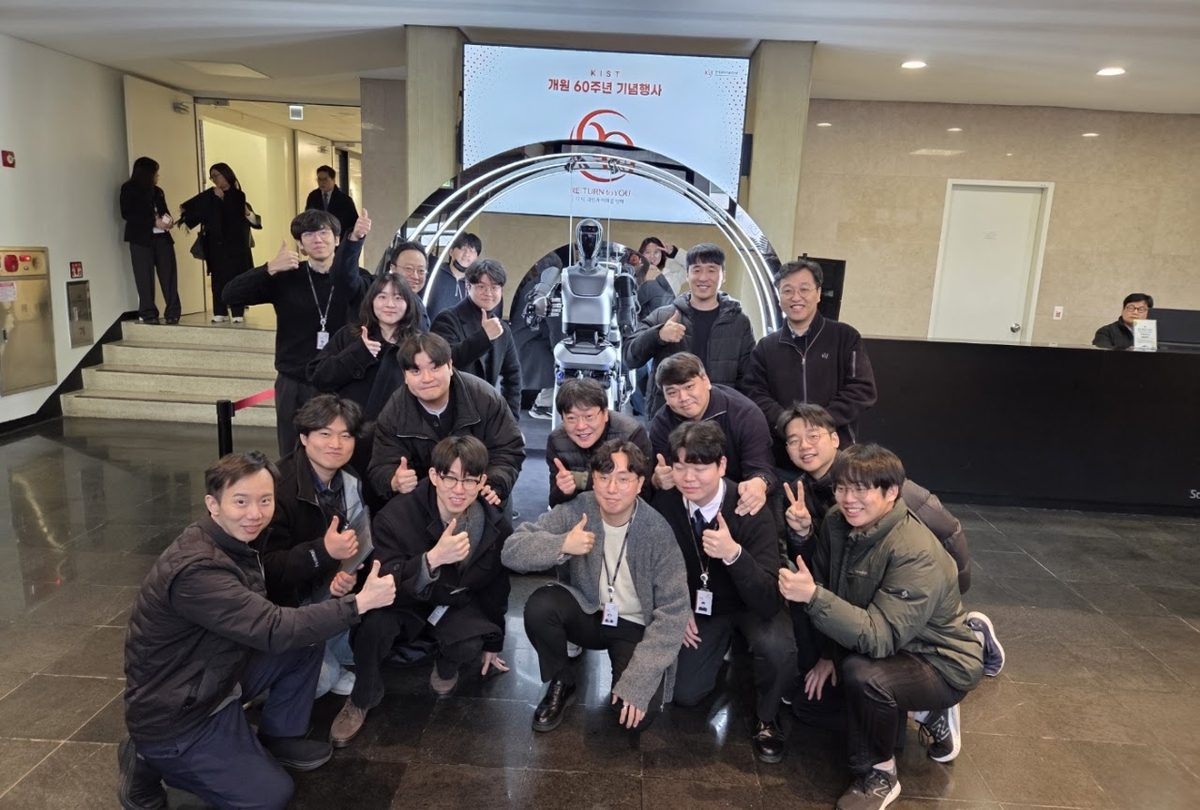
South Korea's Ministry of Science and ICT named Lee Jong-won, head of the Humanoid Research Group at the Korea Institute of Science and Technology's AI and Robot Institute, as the November recipient of the Korea Science and Technology Award on November 4. The honor recognizes his team's work on KAPEX, a humanoid robot built with more than 90% domestically sourced core components, including its actuators, joints, sensors, structural elements and AI control system.
KIST transferred the core KAPEX technology to a consortium led by LG Electronics in September 2025. Under that arrangement, LG Electronics takes the robot platform, LG AI Research develops the physical AI, LG Energy Solution works on all-solid-state batteries, and Robostar handles mass production. Smaller robotics firm WIRobotics, along with Seoul National University, KAIST and Hallym University Sacred Heart Hospital, round out the research consortium.
Why Domestic Sourcing Matters Now
The timing is not incidental. As humanoid supply chains concentrate around a small set of actuator, gearbox and sensor suppliers — many based in China — export controls and tariff disputes have turned component sourcing into a strategic liability for robot makers everywhere. KIST's pitch is that a government-funded research institute, rather than a single company, absorbed the cost of building that supply chain from scratch, then handed a tested platform to industry.
The performance numbers KIST cites back up the engineering claim rather than just the politics: KAPEX actuators generate up to 300 newton-meters of torque, the robot can suspend a 30-kilogram rice sack from a one-meter rod, and KIST says energy efficiency has more than doubled versus its earlier systems. "True technological independence means designing and integrating the components ourselves, and also creating and advancing the AI and training data with our own hands," Lee said.
Where KAPEX Sits Against Rivals
South Korea has been racing to catch up with humanoid leaders in the US and China, and KAPEX is one of several parallel efforts now converging around commercialization. Rainbow Robotics, backed by Samsung, is pushing toward 2027 mass production with its own platforms. Hyundai Mobis has started building actuator prototypes for Boston Dynamics' Atlas. KIST's approach is distinct in that it is explicitly a technology-transfer play: a public research institute de-risking the hardest supply-chain problems before an industrial consortium takes over manufacturing and scale.
That mirrors how Korea built its semiconductor and battery industries, and it gives LG a head start without the years of component-level R&D that Chinese and American rivals have already sunk into their own humanoids. Whether a 90%-domestic humanoid can compete on cost against Chinese platforms benefiting from state subsidies and mature component ecosystems remains the open question. For now, KAPEX is a proof that it can be built at all — commercial volume and price are LG's problem to solve next.
Source: Seoul Economic Daily.