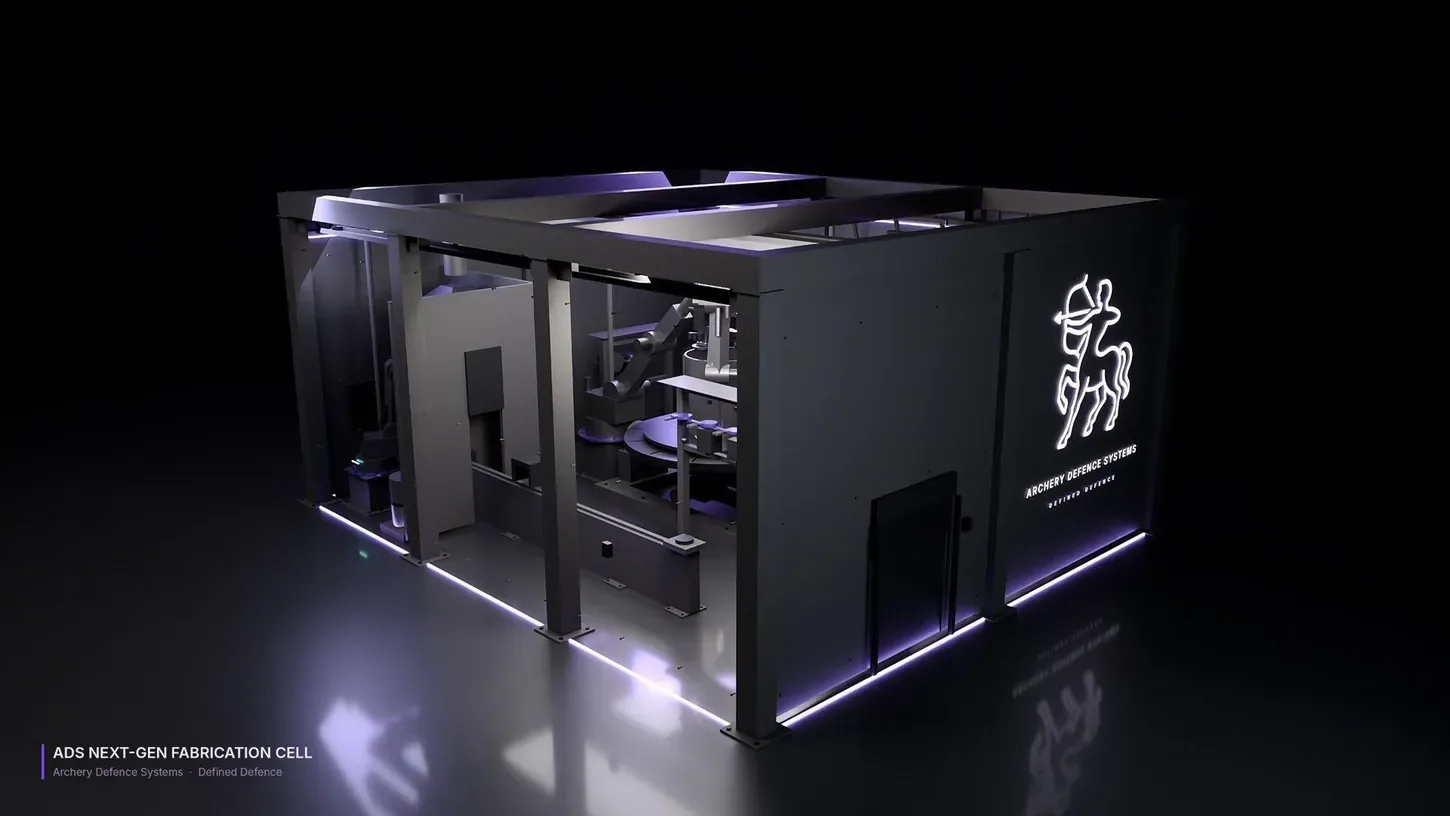
Archery Defence Systems unveiled its Autonomous Fabricator on November 19, a single robotic manufacturing cell that converts a digital design into a finished, inspected defense product with minimal human involvement. The London-based company says one cell can produce 182 unique products, and that a plant of eight cells could turn out roughly 150,000 drones a year for under 100 million euros in capital spending.
The system runs on Velo OS, software built entirely by Archery's own engineering team, and works with advanced polymers, composites, metals and graphene. Archery says the cell takes a design from digital file to physical, inspected product in under 72 hours, a process that normally requires dozens of separate stations, suppliers and tooling runs.
Selling factories, not just drones
Archery's pitch is unusual for a defense contractor: it isn't primarily selling drones, it's selling the means to build them locally. CEO Patrick Fullick described the business model simply: "ADS builds and owns the plant, our partners own the capability." Co-founder and Chief Scientific Officer Stepan Mykhailychenko framed the target customers as Gulf states and allied nations racing to build sovereign defense industries without importing finished weapons. "The Gulf states are building some of the most ambitious defence industries in the world. We give them a factory that thinks in software," he said.
That positioning matters because Gulf defense budgets have increasingly pushed for domestic manufacturing rather than straight arms purchases, and drone attrition in recent conflicts has made rapid, scalable production a priority over handcrafted precision. A plant staffed by roughly 100 skilled workers that can still hit six-figure annual drone output is a different value proposition than traditional aerospace manufacturing lines, which typically need thousands of workers to reach similar volumes.
How it stacks up against existing drone manufacturing
Archery's approach echoes a broader shift toward software-defined, highly automated weapons manufacturing seen elsewhere this year, including UK and Ukrainian drone ventures racing to scale production for the war in Ukraine and beyond. Where those efforts have focused on buying up existing factories or raising large funding rounds to expand conventional lines, Archery is betting that collapsing an entire supply chain into one robotic cell is the faster path to scale, especially for customers who want production capacity on their own soil rather than a shipment of finished drones.
Whether the 150,000-unit figure holds up under real operating conditions remains to be seen, since Archery hasn't yet disclosed a named customer or government contract tied to the system. The company says its near-term focus is the Gulf states and wider Middle East, with export to other allied nations to follow.
Read more at DroneXL.