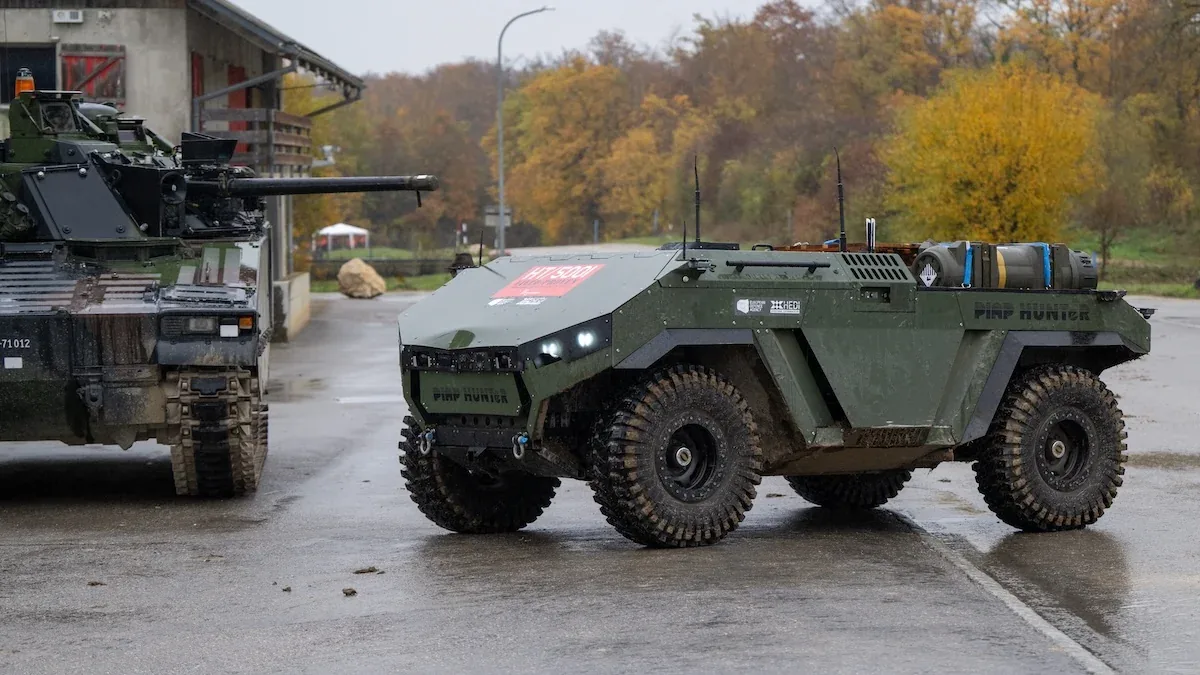
The European Defence Agency and the Swiss Armed Forces spent three days testing drones and uncrewed ground vehicles for battlefield logistics, running the agency's first Operational Experimentation campaign ever held outside European Union territory.
The exercise, called ALPEX LOG, ran from November 10 to 12 at the Bure military training area in Switzerland's Jura region. It drew participants from all 27 EU member states plus host nation Switzerland, alongside defense industry representatives who brought aerial drones, wheeled unmanned ground vehicles and tracked unmanned ground vehicles to be put through urban logistics scenarios.
Soldiers from a Swiss tank battalion and logistics units ran the machines through three core tasks: delivering supplies to deployed troops, evacuating injured personnel, and conducting reconnaissance in built-up areas. The goal was not a product demo. Companies operating the equipment collected direct feedback from military end users on what needs to change before the technology is trusted in real deployments, according to Defence Industry Europe.
Why hosting it outside the EU matters
Switzerland's participation rests on an administrative arrangement with the EDA that was updated in 2025, giving non-EU countries a formal framework to join the agency's trials. Hosting EU OPEX 2026 marks the first time that framework produced a field campaign beyond EU borders, a step Swiss Armed Forces Major General Rolf André Siegenthaler called important for his country's defense cooperation.
EDA Director Nathalie Guichard framed the stakes plainly: innovation only creates defense value once it has been tested, trusted and used by the military. That reflects a broader shift inside European defense circles, where years of slideware pitches about autonomous logistics are giving way to muddy-boots trials with actual soldiers driving, flying and troubleshooting the hardware.
Urban casualty evacuation and resupply are two of the hardest problems in military robotics. Narrow streets, rubble, unreliable GPS signals and the need to move an injured soldier without jostling them further all strain systems that work fine on open terrain. Testing those scenarios in a Swiss urban-training environment, rather than a flat proving ground, signals that European procurement officers want evidence from realistic conditions before writing contracts.
How this fits the broader push toward unmanned logistics
ALPEX LOG lands amid a wave of similar experiments. The U.S. Army fired 18 drones from a single ground robot in a Germany field trial earlier this month, aimed at overwhelming enemy air defenses rather than logistics, but built on the same premise: pairing uncrewed ground vehicles with aerial drones multiplies what a small unit can do without adding personnel risk. The war in Ukraine has pushed resupply and casualty evacuation robots from concept to combat use faster than any peacetime procurement cycle could, and European militaries are visibly trying to close that gap through structured testing rather than waiting for a crisis.
The trials also matter commercially. Dozens of European and allied companies now build logistics-focused unmanned ground vehicles and resupply drones, and government-run exercises like ALPEX LOG are among the few venues where they get direct, unfiltered feedback from the soldiers who would actually use the equipment, rather than from a sales pitch. Companies that performed well at Bure gain a credibility marker for pitching NATO and national defense ministries later.
Field trials are set to become a bigger part of how the EDA validates technology going forward. The agency's new Centre for European Defence Innovation is being built specifically to run more operational experimentation campaigns, with the Swiss trial serving as a template for including non-EU partners.
No contracts were announced coming out of ALPEX LOG, and the EDA has not said when the next OPEX campaign will run or whether it will again involve a non-EU host. The agency's next move will likely come through its new innovation centre, which is expected to turn individual trials like this one into a more continuous testing pipeline.