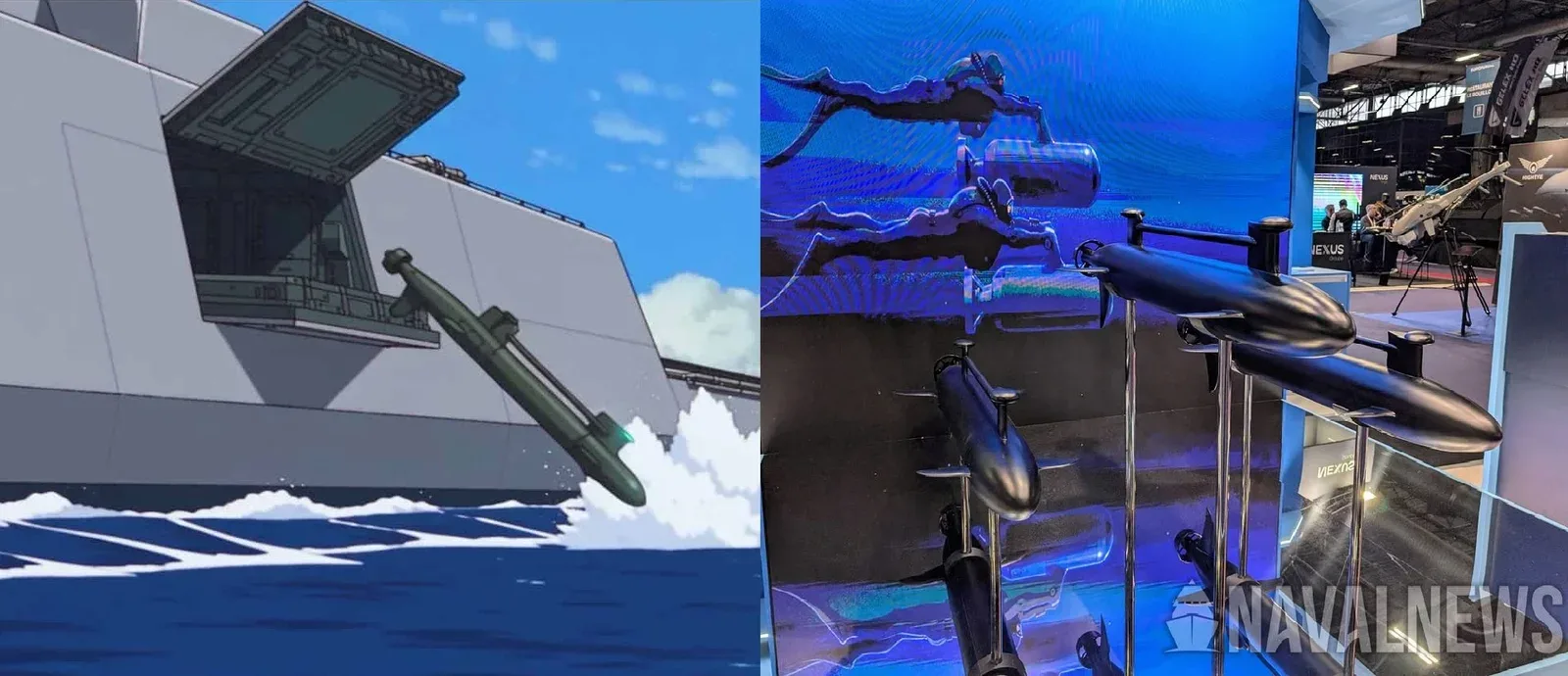
French startup Arsenals unveiled three variants of its modular underwater drone, the Harpoon, on its stand at Euronaval 2026 in Paris, setting a manufacturing target of one vehicle built every hour, according to The Defense News. The company, founded in March 2026 by CEO Bastien Allanot and Félix Vogeli, raised initial funding within two weeks of incorporation and received an investment from Eurazeo in May, then built its first prototype in five weeks at a workshop in Plouharnel, Brittany.
Harpoon is built around a single standardized torpedo-shaped hull with plug-and-play payload modules — seeker heads, warheads, sensors, and mining or counter-mining systems — that can be deployed by hand, from ships, or dropped from aircraft. The vehicle is designed to loiter underwater for months, navigate without GPS, and operate alone or in coordinated formations for ISR, target acquisition, decoy and strike missions. Arsenals now employs more than 20 people and plans to reach 150 within a year, with demonstrations already underway with the French armed forces ahead of a planned 2027 commercial launch.
Why Mass-Producible, Expendable AUVs Matter
Naval mine warfare and undersea surveillance have traditionally relied on small numbers of expensive, specialized autonomous underwater vehicles built for durability and reuse. Arsenals is inverting that model: a common hull built cheaply and in volume, designed to be lost in combat rather than recovered. The pitch mirrors the shift seen in aerial drones, where cheap, disposable FPV systems have displaced costlier precision munitions for many tactical roles.
That logic matters for European navies specifically. Undersea infrastructure — pipelines, communications cables — has become a frequent target of sabotage in the Baltic and North Seas, and existing AUV fleets are too scarce and too expensive to provide persistent coverage. A production model built around a one-hour takt time, yielding 100 vehicles in 100 hours, directly addresses the stockpile problem that has constrained Western naval drone forces.
A Direct Challenge to Anduril
Allanot framed Arsenals explicitly against Anduril's Copperhead underwater drone line, saying "we are ready to race against Anduril. So Palmer, if you want to do an underwater race, let's do it." Anduril has a multi-year head start, deeper defense-sector relationships, and existing Pentagon contracts, giving it scale advantages Arsenals cannot yet match.
Arsenals' counter-bet is speed and European sovereignty. France and other EU states have pushed to reduce reliance on US-built autonomous systems for sensitive undersea missions, and a French-built, French-tested AUV gives Arsenals a political advantage Anduril lacks on that continent, even if its technology is unproven at scale. Whether a company eight months old can deliver manufacturing throughput that established primes have struggled to match remains the central question before its 2027 launch.