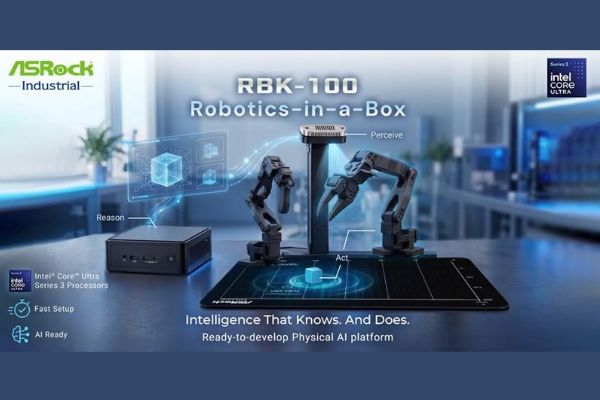
ASRock Industrial unveiled the RBK-100 Robotics-in-a-Box on November 24, 2026, a self-contained development kit that pairs a six-axis leader-and-follower robotic arm set with an Intel-powered mini PC and preloaded AI training software. The company built the platform with Intel to give researchers, educators and developers a single box for collecting robot demonstration data and training manipulation models without assembling hardware from scratch.
The kit centers on ASRock Industrial's NUC BOX-358H, running an Intel Core Ultra X7 358H processor with 32GB of DDR5 memory and a 512GB PCIe Gen4 SSD in the standard configuration, or 64GB in the Advanced tier. An integrated RGB-D camera captures color and depth data, feeding ASRock's AiRoboStarter software, which handles demonstration recording, dataset review, model training and skill execution directly on the device.
Why a boxed robot kit matters now
Physical AI has a data problem before it has a hardware problem. Training a robot to pick, place or assemble requires thousands of recorded demonstrations, and most labs lose weeks just wiring together arms, cameras and compute before collecting a single sample. ASRock Industrial's pitch is that the RBK-100 compresses that setup into a single purchase, with support for established manipulation model workflows including Action Chunking Transformer and Pi0.5, and SmolVLA support planned for a future update.
The Advanced configuration goes further, bundling agentic AI tools directly into the box: speech-to-text, text-to-speech, large language models, visual perception, object detection, web search and custom API hooks that let a trained robot skill be called from a broader software agent. That positions the RBK-100 less as a toy and more as a bridge between classroom robotics kits and the industrial edge computers that companies like Nvidia and Dexterity sell for production deployments.
Competing in a crowded edge AI market
ASRock Industrial is a relatively new entrant in physical AI hardware, having focused historically on industrial motherboards and embedded computing before its October 27, 2026 stock listing. It now competes for lab and classroom budgets against Nvidia's Jetson line, Raspberry Pi-based robot kits, and bundled offerings from humanoid and arm makers chasing the same academic and developer market that trains tomorrow's warehouse and factory robots.
James Lee, ASRock Industrial's chairman, said physical AI represents an important step in bringing intelligence into the physical world and that the company sees \"tremendous potential in making development more accessible and practical.\" Intel vice president John Healy added that scaling physical AI \"requires more than powerful AI\" and that the RBK-100 gives developers an integrated platform to accelerate experimentation.
ASRock Industrial has not disclosed pricing or a ship date for the RBK-100. The company's broader strategy, underscored by its recent public listing, leans on edge AI and cybersecurity as growth areas; a packaged robotics kit gives it a visible entry point into the physical AI training pipeline that increasingly feeds commercial humanoid and arm deployments.