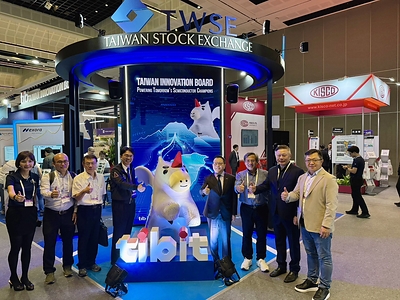
Taipei-listed fabless designer QBit Semiconductor (TWO: 7913) used SEMICON Taiwan 2026 to lay out a physical-AI silicon roadmap centred on a Cerebellar Model Articulation Controller (CMAC) system-on-chip designed to run a 32-motor humanoid hand from a single die, plus a companion processor aimed squarely at the drone market.
QB88XX: One Chip, 32 Motors, Cerebellum-Style Control
The QB88XX combines quad-core Arm Cortex-A78 CPUs and a primary NPU to execute brain-level commands with an Arm Cortex-M7, a proprietary TGEN engine and a secondary NPU dedicated to real-time motor servo loops. QBit says the CMAC architecture consolidates multi-joint control onto one piece of silicon — a direct answer to the space and power headaches that afflict dexterous robotic hands with more than 20 degrees of freedom.
Peripheral integration is aimed at industrial arms as much as humanoid manipulators: PCIe, USB, CAN Bus and camera interfaces feed vision and force sensors, while AI-based servo tuning shifts parameter tweaking off the shop floor.
QB77XX Enters The Drone Market In Two Phases
For unmanned aircraft, QBit is running a phased play. Phase 1, from 2026 through 2028, deploys the QB77XX in the entry-level segment. The SoC pairs up to 32GB of LPDDR5/5X with PCIe, USB 3.2 and GbE, and uses TGEN and an Arm Cortex-M33 to handle real-time flight control — collapsing the mission computer and flight controller onto a single board.
Phase 2, from 2029 onward, ports the same one-chip philosophy to a drone-dedicated QB88XX SoC with optical flow control and target tracking baked in. QBit demonstrated a QB77XX single-object tracking solution at the show that maintained locks through visual occlusions at relative speeds up to 60 km/h and 10-to-15 minute flight endurance, with multi-object tracking slated for Q4 2026.

Post-Quantum Cryptography Built Into The Base Layer
QBit's QB7 cybersecurity series passed U.S. NIST CAVP validation for Post-Quantum Cryptography (PQC) ML-DSA algorithms in 2025, and the company is folding that stack into its drone silicon: PQC-secured boot for device authentication and firmware defence, marketed as a hedge against the day large-scale quantum machines can break today's public-key cryptography.
The roadmap slots QBit alongside a growing bench of silicon plays chasing physical AI — from Arm's Total Design programme and NVIDIA's Jetson Orin Nano 2 at the edge to Meta's MTIA v3 in the data centre — but concentrated on the low-level cerebellum problem rather than the neocortex.
Reporting based on QBit Semiconductor's coverage at SEMICON Taiwan 2026 via PR Newswire and PR Newswire APAC (September 17, 2026).