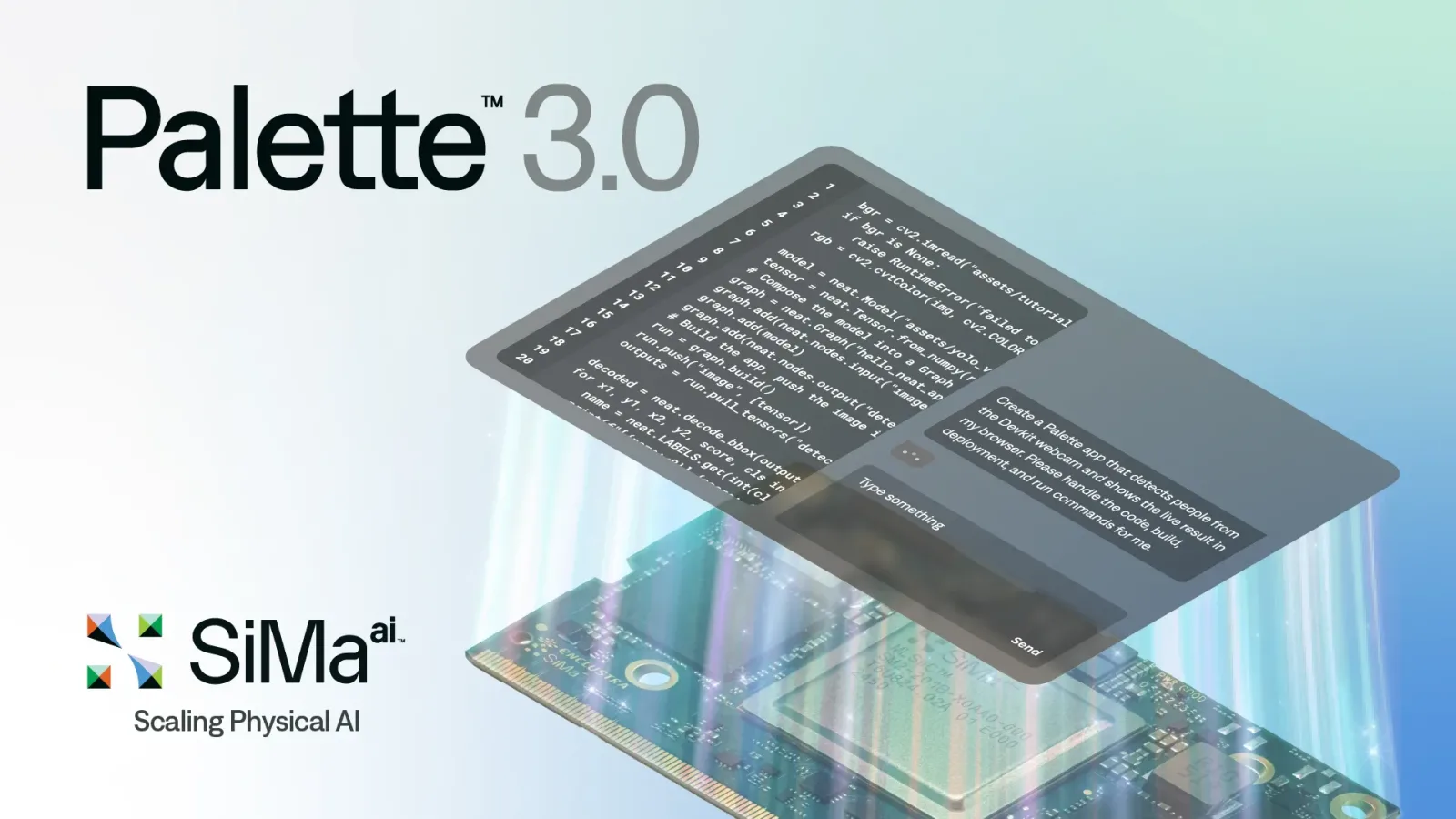
Edge AI chipmaker SiMa.ai released Palette 3.0 on November 17, 2026, a software update that lets its Modalix chips run several AI models at once and process them up to 3.5 times faster within the same power budget, according to Robotics 24/7. The release targets what the industry calls physical AI: software that has to perceive, reason and act in the real world through robots, drones and industrial cameras, rather than just answer a text prompt.
"Hardware at the speed of software," said Krishna Rangasayee, SiMa.ai's founder and CEO, describing the company's approach of squeezing more performance out of existing silicon through better software rather than waiting on new chip generations.
What problem does this actually solve?
A robot or drone usually needs several AI models running simultaneously: one to see obstacles, one to estimate depth, one to reason about what to do next. Running all of those models on a single low-power chip, without them fighting over the same limited memory and compute, is a hard engineering problem. Palette 3.0 addresses it by letting separate applications and even separate software containers share a Modalix chip's accelerator and video engines at the same time, instead of each model claiming the whole chip for itself.
The software also adds support for speculative decoding techniques, including methods called EAGLE3, DFlash and Gemma 4 MTP, which let a chip predict several steps of a model's output at once and check them in batches rather than one token at a time. That is part of how SiMa.ai gets its 3.5x speed claim, alongside support for 16GB modules and mixture-of-experts models like OpenAI's GPT-OSS-20B, a type of model that activates only part of its network for each task to save compute.
Why does this matter for robots and drones specifically?
Most AI chips built for data centers assume a wall outlet and a cooling system; a drone or mobile robot has neither. SiMa.ai's pitch is performance-per-watt rather than raw performance, since a chip that runs hot or drains a battery fast is not useful on a robot arm or a quadcopter regardless of how fast it is on paper. Palette 3.0's sensor fusion and dense neural depth field features are aimed squarely at that use case, combining camera, depth and other sensor data into a single model-ready stream rather than making a robot's compute stack stitch it together separately.
SiMa.ai named AverMedia as a partner integrating the software into drone AI platforms, and the company is making Palette 3.0's capabilities open source, with a public Model Browser showing real-world performance benchmarks for developers building on top of it.
What comes next?
Palette 3.0 builds on an earlier release SiMa.ai calls Agentic Palette, and the company frames this as a continuing push to extract more value from its existing Modalix hardware line through software updates rather than new chip tape-outs. For robotics and drone companies choosing which edge AI chip to design around, the pitch is straightforward: the same silicon purchased today gets measurably faster over time, which matters in an industry where hardware refresh cycles are slow and expensive compared to software updates.