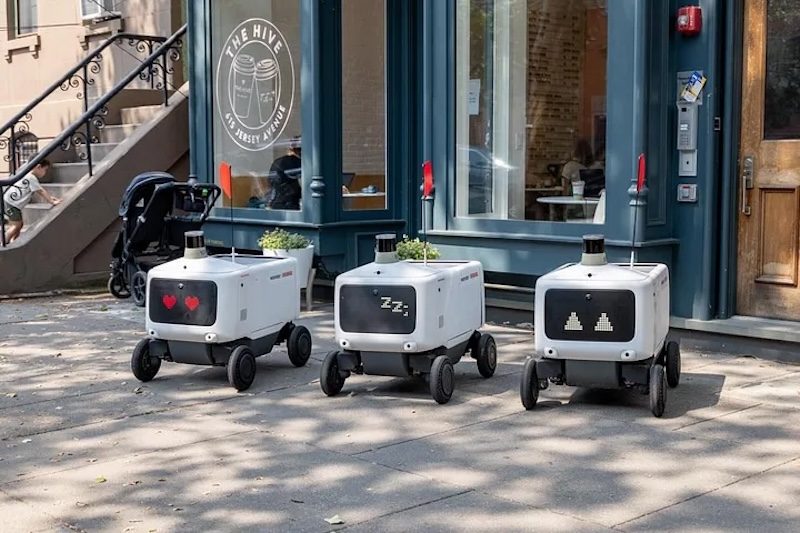
Avride said on November 15 that its fleet of sidewalk delivery robots has completed 1 million autonomous deliveries across more than 30 US markets, from university campuses in Austin and Dallas to city neighborhoods in Jersey City, Philadelphia and Miami. The company says it is now running roughly 7,000 deliveries a day, after October alone accounted for 180,000 trips, according to Robotics & Automation News.
The robots work with Uber Eats and Grubhub: restaurant staff load orders into the bot, customers track it on an app, and a compartment unlocks on arrival. It is a simple loop, but hitting a million repetitions of it says something about where sidewalk delivery robotics has landed after years of pilots that rarely left a single city block.
Why the Million Mark Actually Matters
Delivery robots have spent years stuck in demo mode — a few dozen units circling a handful of blocks near a company's headquarters while executives talked up a future that never quite arrived at scale. Avride's number suggests that future is closer than the skeptics assumed, at least for short, structured trips like last-mile food delivery.
The jump from zero to a million is also a story about compounding. Avride didn't get here by suddenly tripling its fleet; it got here because 180,000 deliveries happened in a single month, which means the per-robot productivity and the geographic footprint have both been climbing steadily. That kind of curve is what turns a curiosity into infrastructure.
It also reframes the economics question that has dogged sidewalk robots since the category began. A robot that completes a handful of trips a day is a novelty; one that's part of a fleet running 7,000 trips daily, spread across 30-plus markets, starts to look like a genuine logistics network rather than a marketing exercise.
Crowded Sidewalks Ahead
Avride isn't alone in this race. Serve Robotics operates roughly 2,000 robots and just opened its delivery network to outside developers through a public API, while Amazon's Scout experiments and various campus-focused players have all tried to crack the same problem. The difference now is less about who has a working robot and more about who has distribution — restaurant partnerships, app integrations and city-by-city permitting.
Uber Eats and Grubhub give Avride access to demand that already exists rather than demand it has to build from scratch, which is a meaningfully different strategy than companies trying to run their own delivery app alongside their hardware. Spreading across university towns, where pedestrian traffic is dense but slow-moving, has also let Avride rack up volume in lower-risk environments before pushing further into complex city streets.
The next test is whether growth holds up outside those friendlier environments. Avride's 30-plus markets already include dense cities like Miami and Philadelphia, so the company has started answering that question. Whether daily volume keeps climbing toward the next million will depend less on the robots themselves and more on how many restaurants, cities and competitors are willing to make room for them.