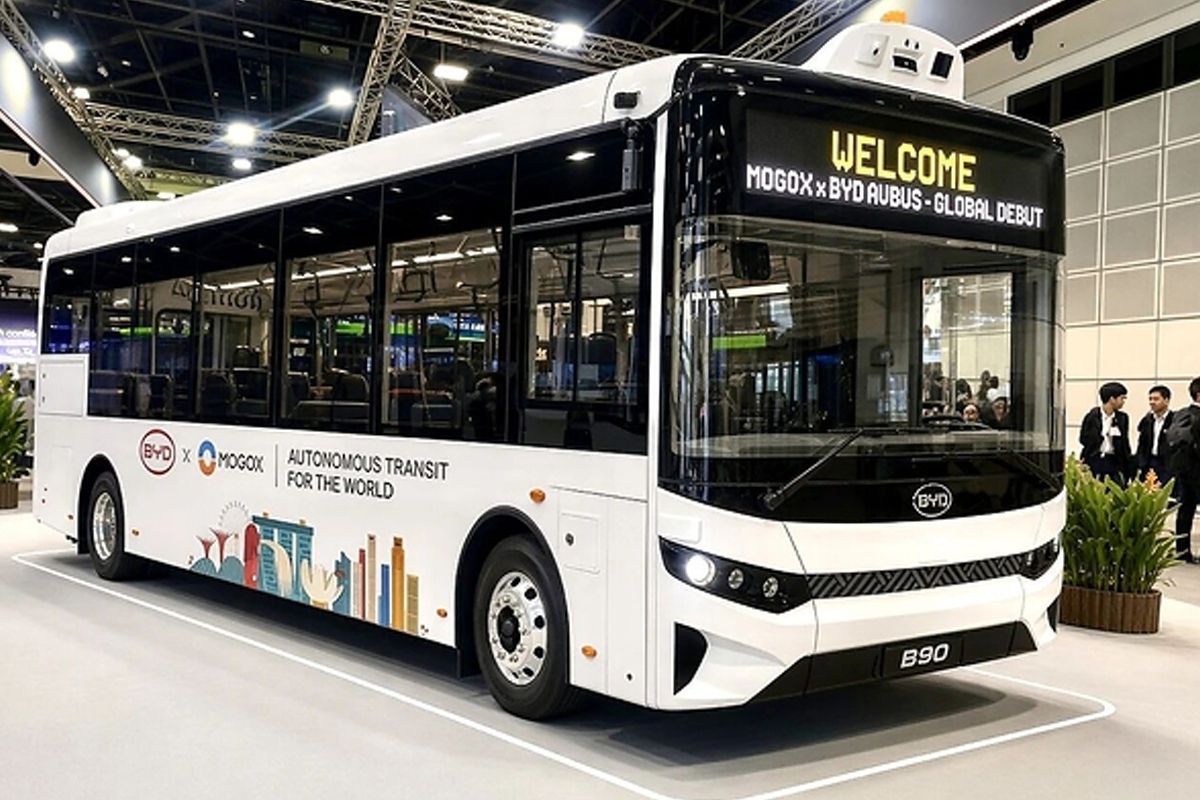
BYD and Beijing-based autonomous driving firm MOGOX showed off the B90, an 8.5-metre, right-hand-drive, Level 4 autonomous electric bus, at Singapore Urban Mobility Week on November 13, 2026. It's the first vehicle the two companies have built specifically for left-hand-traffic, right-hand-drive markets, and it marks MOGOX's first public step outside its home turf of mainland China.
What exactly did BYD and MOGOX show in Singapore?
What exactly did BYD and MOGOX show in Singapore?
The B90 pairs BYD's electric bus chassis and battery engineering with MOGOX's MOGO AutoPilot software stack. The bus has a low-floor layout with an ultra-short rear overhang, and its sensor suite combines cameras with solid-state lidar rather than the spinning mechanical lidar units common on earlier-generation autonomous vehicles. MOGOX says the system is built to handle mixed traffic, intersections and bus-stop approaches, the three scenarios that trip up most low-speed autonomous shuttles.
The debut was a global first for the jointly developed model, shown live at the Singapore event rather than in a closed test track or simulation. No fleet size or commercial start date for Singapore has been announced yet.
How is this different from what MOGOX already runs in China?
MOGOX's MOGOBUS vehicles are already operating in more than 20 Chinese cities, covering transit routes, tourism shuttles and campus or park shuttle service. Those deployments all run on left-hand-drive vehicles built for China's right-hand traffic rules. The Singapore version required MOGOX to localize its stack for the mirror-image rules of left-hand traffic, which affects everything from lane-change logic to how the system reads signage and judges gaps at intersections.
MOGOX frames this as proof of a modular architecture spanning seven adaptation areas: regulations, applications, vehicle platforms, autonomous driving configurations, operating conditions, fleet management and local service networks. In practice, that means the same underlying software can, in theory, be re-tuned for a new country's traffic code without a full rebuild.
Why does right-hand-drive matter so much here?
Most of the autonomous bus and robotaxi operators with real deployment mileage, including Baidu's Apollo Go, WeRide and Pony.ai, built their track records in left-hand-drive China. Scaling into right-hand-drive markets like Singapore, the UK, Australia and much of Southeast Asia means re-validating perception and planning systems against a different set of road habits, not just flipping a software flag. BYD and MOGOX getting a working right-hand-drive Level 4 bus onto Singapore streets, even for a demonstration, is a credibility marker aimed at transit authorities weighing autonomous options across the region.
What happens next?
MOGOX already has international partnerships in Luxembourg and South Korea, and the company describes the Singapore showing as part of a broader push to localize its platform for right-hand-drive markets. For BYD, the project extends its ambitions beyond passenger EVs and robotaxis into public transit automation, an area where it competes less directly with Tesla and more with established bus manufacturers now racing to bolt autonomy onto their own platforms.
The autonomous bus and shuttle market remains early-stage globally, with most fleets still numbering in the dozens rather than hundreds of vehicles per city. A successful right-hand-drive deployment in Singapore, even a modest pilot, would give BYD and MOGOX a reference project to point to when bidding for transit contracts elsewhere in Southeast Asia.