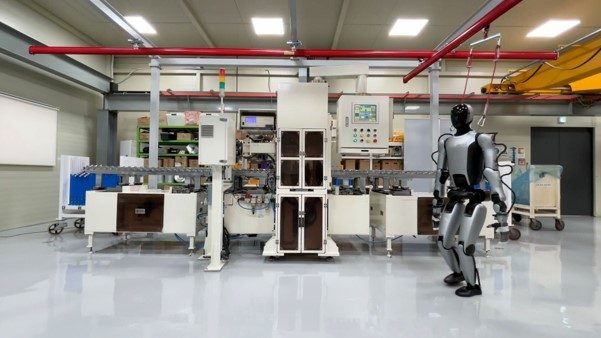
South Korean robotics firm Bigwave Robotics said on November 24 that it successfully ran a bipedal humanoid robot through a live pilot on a domestic auto-parts manufacturing line, linking the robot directly to the plant's programmable logic controllers to complete an engine-part calibration process. The company called it the first time a bipedal humanoid has integrated this tightly with existing mass-production equipment in South Korea.
Key takeaways
- Bigwave Robotics' bipedal humanoid walked 10 meters at an unnamed auto-parts facility and performed engine-part calibration tied to existing production equipment.
- CTO Song Jun-bong said it is the first case in South Korea of a bipedal humanoid tightly integrating with PLCs on a mass-production line.
- The robot ran on Bigwave's Hyper Foundry physical AI platform, trained with reinforcement learning and imitation learning in virtual environments before deployment.
- Humanoid-related work now makes up about 20% of Bigwave's total revenue this year.
- Bigwave previously delivered robot solutions to heavy industry affiliates, cosmetics makers and other auto-parts manufacturers.
According to Digital Today, the pilot's significance lies less in the robot's walk and more in the wiring behind it. Bigwave trained its models through millions of simulated repetitions before transferring them to physical hardware, a step meant to cut the time it normally takes to tune a humanoid for a specific factory floor. Song said the system completed the calibration process "consecutively" once connected to the plant's existing equipment, rather than requiring a separate test cell built around the robot.
Why PLC integration matters more than it sounds
Most humanoid robot demonstrations show a robot performing a task in isolation — walking, grasping, carrying. Tying a humanoid directly into a factory's programmable logic controllers, the decades-old backbone of industrial automation, is a different and arguably harder problem, because it means the robot has to operate as a trusted node inside an existing production system rather than a standalone novelty act next to it. That is the gap many humanoid makers, from Agility Robotics to Figure, are racing to close as they move from lab demos to factory floors.
Korea's crowded humanoid race
Bigwave is one of several Korean firms pushing humanoids into industrial settings alongside bigger names like Hyundai-backed Boston Dynamics and Rainbow Robotics. The company's own event, BIGWAVE SHIFT 2026, brought in Nvidia and other partners to showcase its Hyper Foundry platform, which bundles data collection, model training and deployment into a single pipeline. With humanoid work already at a fifth of revenue, Bigwave is betting that proving out tight factory integration — not just flashy mobility — will be what separates pilots that scale from pilots that stall.