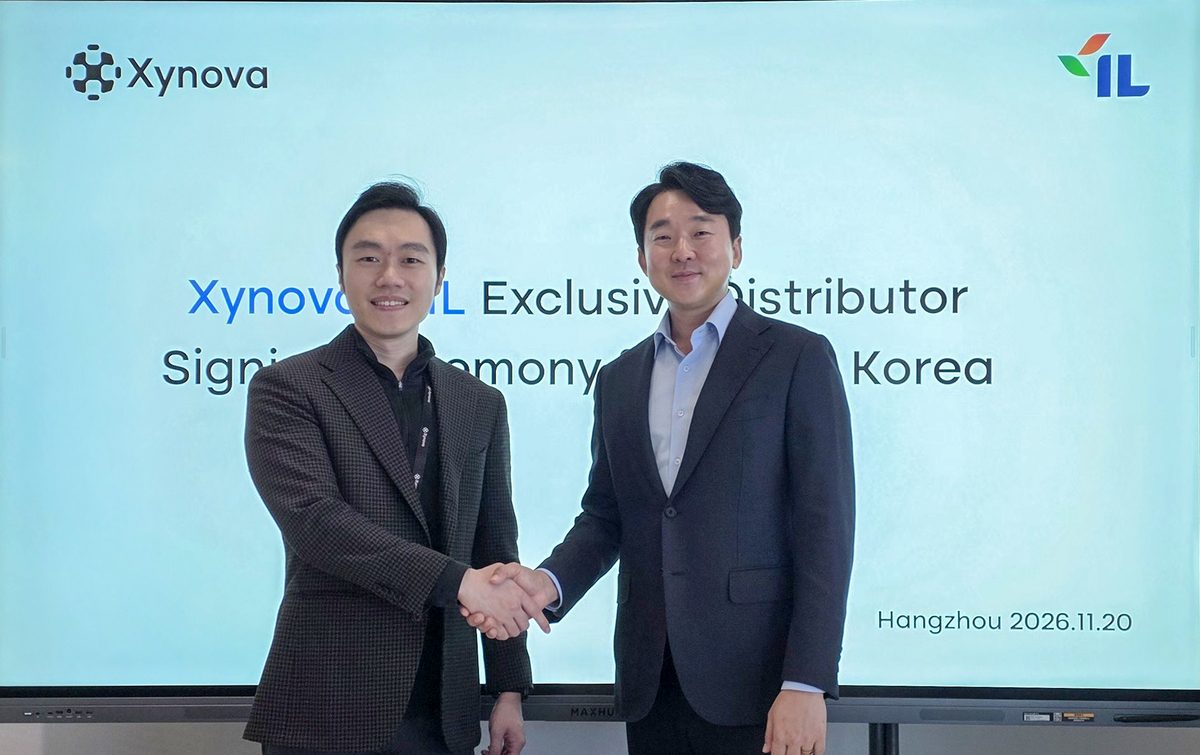
South Korean physical-AI data company IL Corp has signed an exclusive agreement to be the sole distributor in South Korea for robot hands and joint actuators made by XYNOVA, the Hangzhou-based robot-hand specialist, with the two sides finalizing the deal at XYNOVA's China headquarters on November 20.
The agreement covers XYNOVA's full lineup of robotic hands and its joint actuator line, giving IL the only legal channel to sell the components inside Korea, according to The Seoul Economic Daily. IL Corp chairman Song Sung-keun and XYNOVA founder and chief executive Xia Weixuan signed the agreement in person in Hangzhou.
A fast-growing Chinese robot-hand unicorn
Founded in late 2024, XYNOVA has raised roughly 1.5 billion yuan (about 302.2 billion won, or $205 million) to date and crossed a $1 billion valuation in July 2026. Its flagship Flex2 hand combines wire-driven and direct-drive mechanisms — what the company describes as the industry's first hybrid-drive robot hand — packing 23 degrees of freedom along with tactile, proximity and vision sensors for precision gripping and object manipulation.
Robot hands have become one of the most closely watched sub-markets in humanoid robotics, since dexterity rather than locomotion is widely seen as the harder unsolved problem standing between today's demos and robots capable of general-purpose factory or household work. A hand with 23 degrees of freedom and integrated tactile sensing puts XYNOVA's hardware in direct competition with other specialist hand makers racing to supply humanoid builders that don't want to design manipulators in-house.
Why Korea wanted an exclusive deal
For IL Corp, exclusivity buys a domestic foothold in a component category Korean humanoid makers currently have to source from abroad piecemeal, often through multiple intermediaries. "Robot hand technology is the core competitive edge" for industrial humanoids attempting precision tasks, Song said, framing the deal as a way to supply Korean humanoid manufacturers, systems integrators and industrial automation firms directly while also capturing operational data generated by the hands in the field — data IL intends to feed back into its own AI training business.
The deal fits a broader pattern this year of Korean robotics and electronics firms turning to Chinese component suppliers for parts — hands, actuators, sensors — that are maturing faster and more cheaply inside China's dense supply chain than equivalents built domestically or sourced from Japan, Europe or the US. South Korea's government has separately committed hundreds of millions of dollars to building a local humanoid-parts supply chain, targeting majority domestic sourcing by 2030, which makes IL's bet on an exclusive Chinese supplier something of a hedge against that homegrown effort arriving too slowly to matter.
Neither company disclosed order volumes or a shipment timeline under the new agreement. What happens next depends on how quickly IL can get XYNOVA's hands into the hands of Korean humanoid builders — and whether exclusivity proves durable if a domestic Korean competitor to XYNOVA emerges before 2030.