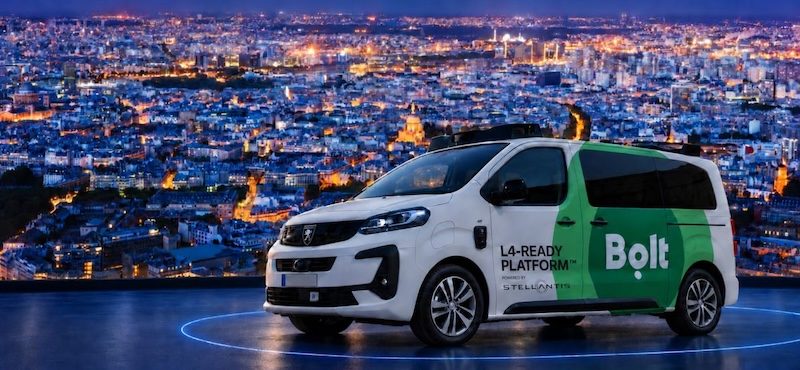
Bolt, Stellantis and the Métropole du Grand Paris announced plans on November 19, 2026, to launch autonomous vehicle trials across Greater Paris starting in 2028, with an initial pilot in up to five municipalities in the northwest of the region before expanding to more than 30 municipalities by 2030. The three partners are submitting the project, called the Greater Paris Autonomous Driving Living Lab, to the European Commission's Autonomous Drive Ambition Cities program, according to Robotics and Automation News.
Stellantis will supply Level 4-ready vehicle platforms, Bolt will handle service integration and bookings through its app, and the plan leans on Nvidia's Hyperion computing hardware and Halos safety system, with Pony.ai named as a potential autonomous driving technology provider. Greater Paris has roughly 7.2 million residents, and the pilot is framed around first- and last-mile connections to public transit rather than replacing it. Bolt CEO Markus Villig summed up the pitch: "Autonomous vehicles will only matter if they solve real transport problems."
Why Europe's Robotaxi Race Is Starting With Transit Integration, Not Downtown Loops
Most high-profile robotaxi launches — Waymo in US cities, Pony.ai and Toyota's bZ4X service in Guangzhou — began as standalone ride-hailing fleets chasing the same downtown trips as human-driven taxis. The Greater Paris plan is pitched differently: the stated goal is evaluating how driverless vehicles slot into existing transit, covering the first-and-last-mile gap that buses and trains leave in suburban municipalities. That framing matters for winning over a regional authority and unions wary of job displacement, and for the ADACities funding application, which rewards projects showing public-transport complementarity over pure commercial competition.
It's also a hedge against the operational mess that has tripped up AV rollouts elsewhere. Waymo was pulled off freeways nationwide after a California DMV safety order, and a driverless mining truck went off-road in Chile after losing signal — reminders that regulators move fast against autonomous fleets the moment something goes wrong. Starting with five municipalities instead of all of Greater Paris, built around safety, passenger-acceptance and economic-impact assessments, is a deliberate attempt to avoid that kind of backlash before scaling to 30-plus municipalities by 2030.
Stellantis Hedges Across Multiple AV Bets at Once
The Paris plan lands the same week Stellantis also announced a separate collaboration with Wayve and Nvidia, backed by the French government, to accelerate autonomous driving more broadly in France. Running parallel partnerships — Bolt for the ride-hailing layer, Wayve for AI driving software, Pony.ai as a named backup option — suggests Stellantis isn't betting on a single AV technology stack the way General Motors did with Cruise or Ford did with Argo AI, both shut down after burning through billions.
That diversification is rational given how many AV technology providers have failed to reach commercial scale, but it also means Stellantis hasn't committed to whose software actually drives the cars in Paris. With 2028 still two years away and a non-binding program submission the only concrete step taken so far, the announcement reads more as a positioning move in Europe's robotaxi land grab than a locked-in deployment plan.