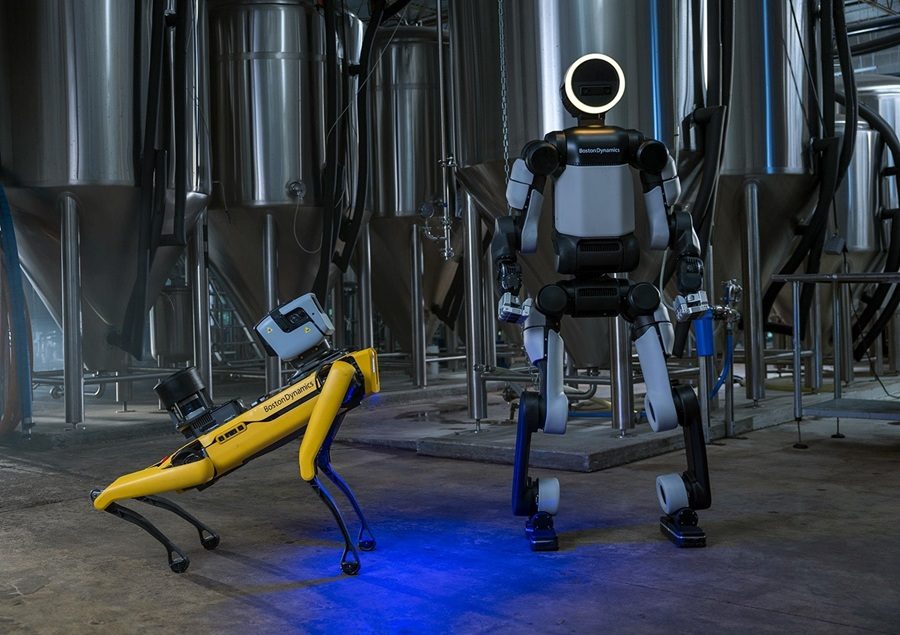
Boston Dynamics and GlobalFoundries are scaling up one of the longest-running industrial robot partnerships in the business, adding more Spot quadrupeds to chip plants on three continents while setting up a 2027 test run for the humanoid Atlas inside the same factories.
How many robots are actually walking GlobalFoundries' floors right now?
In Singapore alone, two Spot units have completed more than 90,000 inspections and covered nearly 900 kilometers moving through sub-fab areas since April, according to Auganix. That is roughly the distance from Singapore to Bangkok and back, walked entirely between racks of fabrication equipment rather than on open roads.
Spot is also deployed at GlobalFoundries sites in Malta, New York; Burlington, Vermont; and Dresden, Germany. Burlington has the longest track record of the group, having run the robot continuously for more than four years — one of the most durable quadruped deployments in any factory setting, inside or outside the semiconductor industry.
What does a 99% mission success rate actually mean on a fab floor?
It means Spot completed its assigned inspection route and returned usable sensor data in 99 out of 100 missions in Singapore, a reliability figure GlobalFoundries now leans on for scheduling maintenance rather than treating the robot as a novelty. Chief Manufacturing Officer Pradip Singh said the robot has helped the company "shift from reactive to predictive maintenance, collecting data across thousands of inspection points to prevent downtime."
That shift carries real financial weight in chipmaking, where unplanned equipment failure mid-process can ruin an entire batch of wafers rather than simply halting a line. In a two-week stretch using updated hardware and software, the Singapore team redeployed Spot across 875 routine inspections, a pace the companies point to as evidence the system scales beyond a handful of showcase robots.
Why is Atlas joining the inspection fleet in 2027?
GlobalFoundries will become the first customer outside the automotive industry to test Boston Dynamics' electric Atlas humanoid, with trials beginning in early 2027. Where Spot inspects, Atlas is built for manipulation — tasks like picking up parts, turning valves, or swapping components that currently require a technician to walk onto the floor.
Boston Dynamics' Chief Product and Technology Officer, Zack Jackowski, said GlobalFoundries "was one of our earliest customers to adopt Spot, and we are excited to see the program continue scaling across the globe." The pairing points to a longer-term plan already visible in the company's own marketing: quadrupeds that find problems, and humanoids that go fix them, with no person walking the floor for either job.
How does this compare to other robots roaming factory floors?
Spot competes with quadrupeds such as ANYbotics' ANYmal and offerings from Deep Robotics, both pitched for similar inspection work in industrial and hazardous settings. What sets the GlobalFoundries deployment apart is scale and tenure: four straight years of operation at one site, plus a footprint spanning the United States, Germany and Singapore, is a harder bar for newer entrants to clear.
For Boston Dynamics, now wholly owned by Hyundai after this year's buyout, the expansion doubles as a proof point for anyone questioning whether Spot's inspection business can generate steady, recurring revenue rather than one-off pilot fees. Chipmakers racing to keep fabs running around the clock give the company a customer base with a direct financial reason to keep paying for uptime, not just a demo.