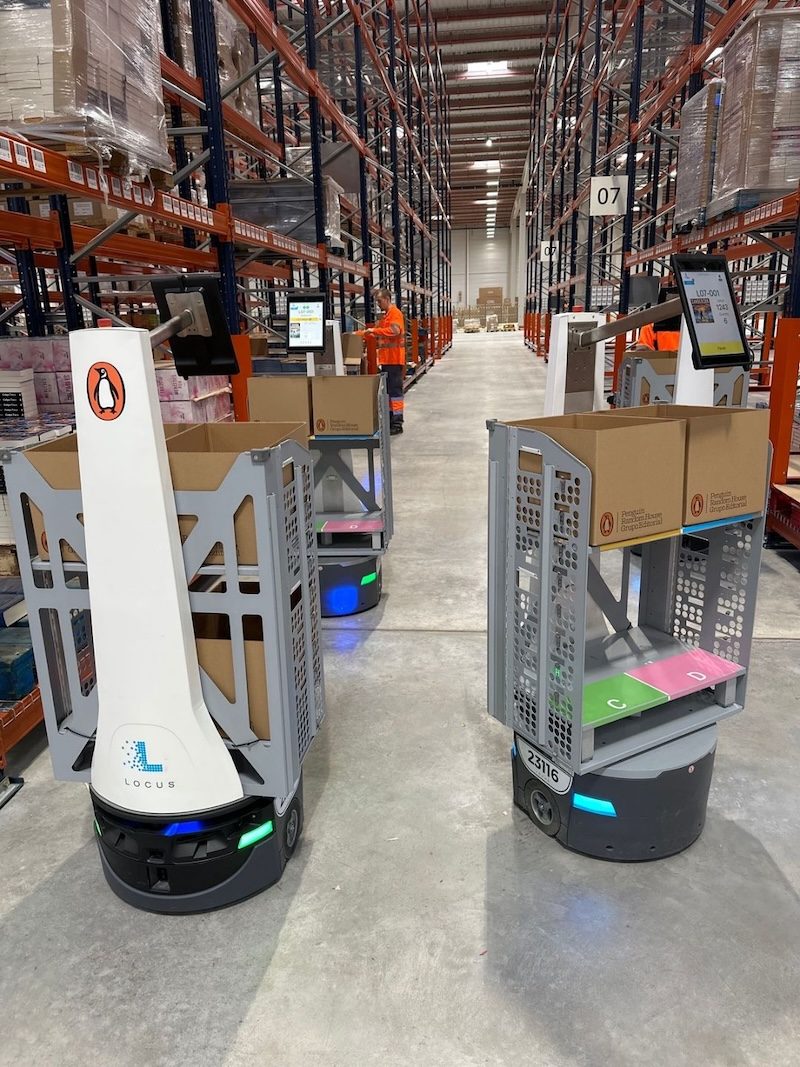
Penguin Random House Grupo Editorial has more than doubled picking productivity at its Barcelona distribution center after scaling its Locus Robotics deployment from 14 to 40 Origin robots, the companies announced November 17, 2026. The facility now handles over 1.5 million units a month at 510 units picked per hour, compared with a 253-unit-per-hour manual baseline before the robots arrived.
Locus Robotics, which supplies autonomous mobile robots that guide warehouse staff through order picking, first deployed at the Spanish Penguin Random House facility in June 2022. The operation moved to a new facility in October 2024 and grew its SKU coverage from about 100 to nearly 1,000 titles within ten months of relocating, a tenfold increase that the companies attribute to the system's ability to handle shifting inventory without reprogramming.
Why Book Distribution Is a Hard Automation Problem
Publishing logistics is an unusually variable warehouse environment. Order sizes swing from single-copy consumer orders to pallet-scale bookstore shipments, and the SKU mix changes constantly as new titles launch and backlist stock rotates. Denis Niezgoda, Locus Robotics' chief commercial officer for international markets, said "book distribution creates constant variability across SKU mix, order composition, and demand timing," which is precisely the kind of unpredictability that goods-to-person robotic systems are built to absorb without requiring a redesigned warehouse layout.
Martí Torra, logistics and distribution director for Penguin Random House Grupo Editorial in Spain, said Locus Robotics "was very easy to implement, scalable within minutes, friendly with operators, and delivered results from day one." That ease-of-scaling claim matters competitively: Locus competes with other goods-to-person automation providers for retail and publishing clients that need to add capacity incrementally rather than commit to a single large automation build.
What Happens Next
Penguin Random House's Spanish unit, part of Bertelsmann, has not said whether it plans further robot additions beyond the current 40-unit fleet or whether the deployment model will be replicated at other Penguin Random House distribution sites in Europe. The jump from 14 to 40 robots alongside the SKU and volume growth suggests the publisher is treating the Barcelona site as a template it can scale rather than a one-off pilot, and other publishing logistics operators will likely watch whether the productivity gains hold as peak holiday order volumes hit in the coming weeks.