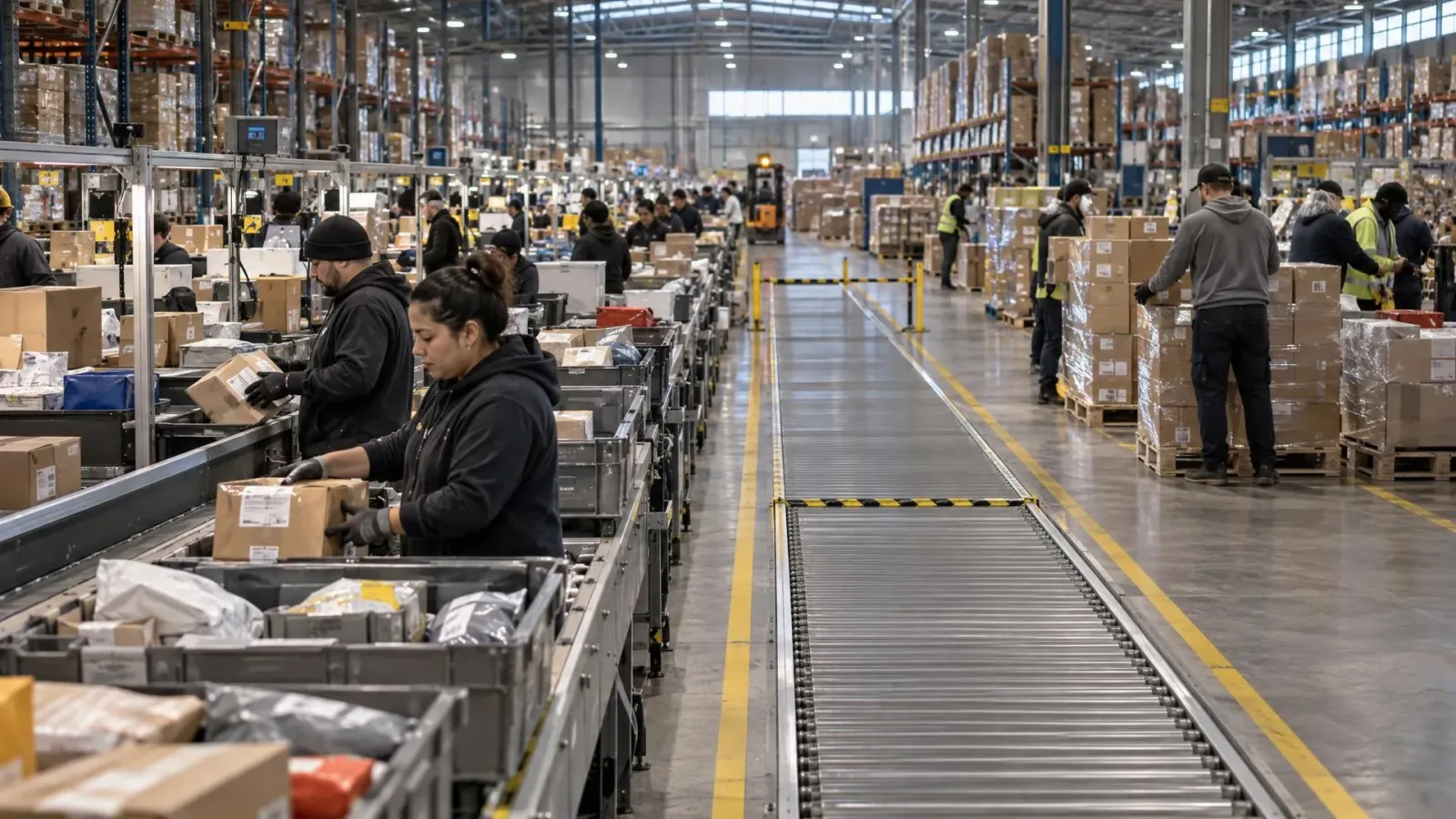
Alibaba's logistics arm Cainiao said this week it will open its global warehouse network to outside robotics and AI companies, launching a program that lets hardware makers test, train and validate robots inside live, operating warehouses rather than in a lab. The announcement came at a launch event at Hong Kong Smart Port on November 5.
Cainiao operates more than 40 overseas warehouses across 18 countries, handling everything from cross-border parcel consolidation to last-mile delivery for e-commerce, FMCG and auto-parts clients. Under the new program, robotics companies can run pilots inside those facilities across use cases including warehouse picking, intelligent navigation, high-altitude inspection, security patrol, aviation logistics and auto-parts handling, covering tasks from parcel feeding and labeling to complex palletizing.
A logistics company turned robot test bed
Cainiao is pairing the warehouse access with a new logistics service it calls "Global Tech in Three Days," aimed at hardware startups that need to move prototypes and early production units across borders fast. The service bundles customs clearance, forward and reverse logistics, high-value cargo insurance, and spare-parts warehousing into three shipping tiers: express shipping for R&D samples and demo units, air freight for large equipment, and warehouse-network stocking for regional inventory. Cainiao CEO William Xiong described the strategy as applying the company's "e-commerce logistics experience to intelligent-technology hardware," effectively repositioning Cainiao as infrastructure for the robotics industry rather than just a shipper of the goods robots might one day move.
The company says it wants to build the world's largest "real-scene training cluster" for embodied AI, with pilot deployments already running in express delivery, e-commerce, FMCG and auto-parts facilities, and plans to extend the program to warehouses in Hong Kong, the Netherlands, Spain, France, Germany and the United States.
Why warehouses matter more than labs
The move reflects a broader shift among robotics companies and the AI models that drive them: simulated environments and lab demos can only get a navigation or manipulation system so far, and the gap between lab performance and real-world reliability remains the industry's biggest bottleneck. Competitors are converging on the same idea from different directions. Amazon has used its own fulfillment centers to train and test robots like Proteus for years, and Walmart's expanding automation partnerships with vendors like Symbotic serve a similar internal function. Cainiao's pitch is that it can offer that same real-world training ground to outside companies as a paid service, turning warehouse floor space into a resource it rents out rather than keeps proprietary.
If the program gains traction, it could give robotics startups that lack their own logistics networks, in China and abroad, a faster, cheaper path from prototype to field-tested product, while giving Cainiao a stake in whichever embodied-AI platforms end up winning. It also puts Cainiao in competition with a growing list of companies, from component suppliers to cloud providers, trying to position themselves as the essential middle layer between robot builders and robot buyers.