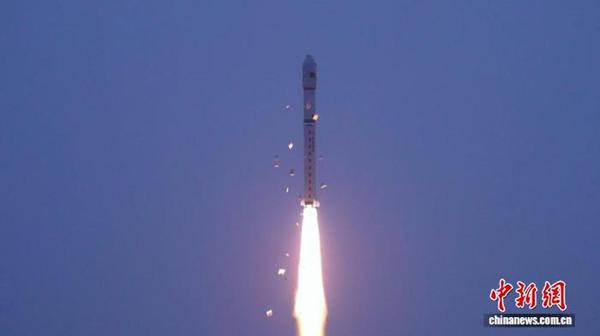
China lofted four PIESAT-2 synthetic-aperture radar satellites to sun-synchronous orbit on September 19, 2026, growing one of the country's largest commercial SAR constellations to twelve second-generation birds on a single Long March 2D flight.
The Launch
The Long March 2D (serial Y104) lifted off from Launch Complex 9 at the Taiyuan Satellite Launch Center at 18:50 China Standard Time. Its payload — PIESAT-2 satellites numbered 13, 14, 15 and 16 — separated cleanly into a 700-km sun-synchronous orbit. The mission was the 106th Long March 2D flight, the 668th Long March flight overall and China's 67th orbital launch of 2026, keeping the country on track for another record year.
Built By GalaxySpace, Operated By PIESAT
All four satellites were manufactured by GalaxySpace, the Beijing-based commercial satellite maker that has become one of China's most active SAR platforms. The birds are operated by PIESAT Information Technology through its Zhuzhou Space Interstellar Satellite Technology subsidiary, and each carries an SAR payload plus onboard compute for real-time processing before the imagery is downlinked — a feature that reduces latency for defence-adjacent and disaster-response customers.

Twelve Satellites, One Constellation Story
PIESAT-2 now stands at 12 satellites in orbit, following earlier launches in November and December 2024 and following on from the first-generation PIESAT-1 that has been operational since March 2023. The constellation supplies commercial radar imagery to domestic Chinese customers across land use, maritime monitoring, disaster relief and agriculture — sectors where SAR's ability to see through cloud and darkness is decisive.
Context: China's Commercial SAR Push
The PIESAT-2 build-out is one of several commercial SAR programs Chinese operators are scaling in parallel, and it fits GalaxySpace's own recent turnkey export deal in Southeast Asia. Together they signal a shift from a research-heavy Chinese space sector toward a commercial-imagery layer that is competitive with U.S. incumbents like ICEYE and Capella Space.
Reporting based on coverage from CNS, Global Times, China in Space, and People's Daily.