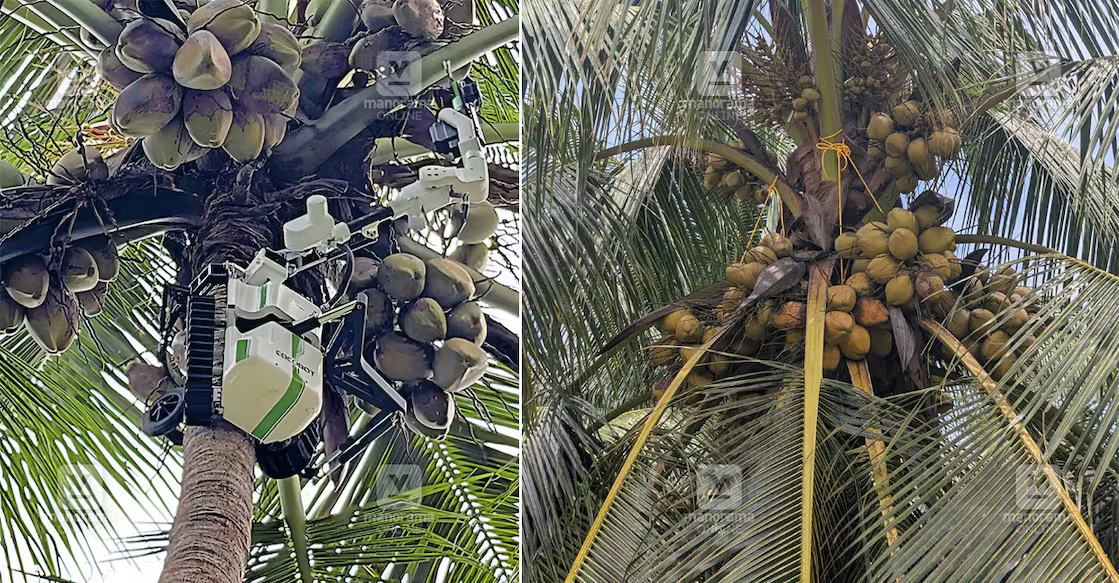
A Kerala-based startup has built a robot that can scale a coconut palm up to 20 meters tall in about a minute, part of a push to automate one of India's most dangerous and increasingly short-staffed agricultural jobs. AlterSage, based in Kozhikode, showed an upgraded version of its Cocobot at the Huddle Global 2026 startup conclave in Kovalam this week, with a commercial launch planned for 2027 at an expected price of around ₹4 lakh (roughly $4,800), according to Onmanorama.
The robot's battery recharges in 45 minutes and delivers up to 1.5 hours of continuous operation, enough to work through dozens of trees in a single charge cycle.
How does a robot climb a coconut tree?
Coconut palms are tall, smooth-barked and often leaning, which is why human climbers traditionally rely on years of practiced footwork, a short loop of rope around their ankles, and no safety harness. It is also why falls remain one of the leading causes of injury and death among agricultural workers in coconut-growing regions. Cocobot replaces that climb with a mechanical gripping system that clamps around the trunk and works its way upward, reaching the crown of a 20-meter tree in roughly a minute based on AlterSage's figures. Once at the top, a dedicated robotic arm reaches into the cluster of coconuts and detaches them, rather than cutting the entire bunch loose to fall and potentially shatter or injure anyone standing below.
That two-part design — a climbing mechanism separate from a harvesting arm — mirrors a split that shows up across agricultural robotics generally. Mobility, getting the machine to the work, and manipulation, actually doing the work, are different engineering problems, and most successful farm robots, from weeding machines to fruit pickers, solve them as two distinct systems rather than one.
Why does this matter beyond one farm gadget?
Kerala and other Indian coconut-growing states have faced a well-documented shortage of trained tree climbers for years, as the physically demanding, high-risk work becomes less attractive to younger workers with other options. Coconut farming is a significant part of the regional economy, and a labor gap at harvest time translates directly into lost income for farmers who can't get their crop down safely or on schedule.
AlterSage's founder, Ashin P Krishna, has said the idea traces back to 2020, when he was a higher-secondary student who could see a coconut grove from his bathroom window and started sketching an automated alternative to climbing. That origin story matters less than the fact that the company has since built a working prototype that performed in front of investors: Huddle Global 2026 drew more than 76 venture capital firms and over 50 angel investors, the kind of audience that can turn a student project into a funded company.
What has to happen before this shows up on farms?
A ₹4 lakh price tag, with government agricultural subsidies potentially offsetting part of the cost, puts Cocobot in reach of cooperative farming groups and larger plantation owners more easily than individual smallholders, who make up a large share of coconut growers in India. The company says it's targeting a market launch in 2027, which gives it roughly a year to prove the robot can handle the variation that exists between farms: trees that lean at different angles, bark conditions that vary with age and climate, and clusters of coconuts that don't always sit where a robotic arm expects them.
If AlterSage can clear that bar, Cocobot would join a small but growing list of robots built for specific, high-value crops rather than row farming, a reminder that agricultural automation isn't only about tractors and drones, but also about jobs too dangerous or too scarce in labor to keep doing by hand.