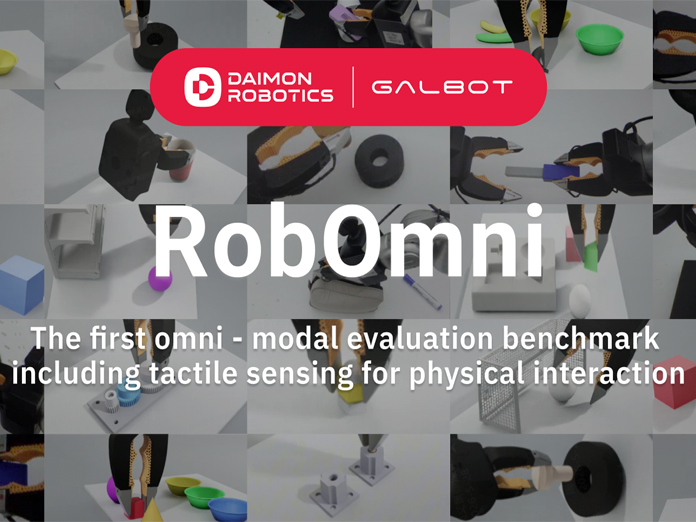
As embodied AI advances toward physical AI and world models, robots are expected to do more than perceive - they must understand and act through physical contact. At ICRA 2026, Daimon Robotics and Galbot jointly launched RobOmni, billed as the first omni-modal evaluation benchmark to include tactile sensing for physical interaction.
Why touch needs a benchmark
Vision alone is often insufficient for grasping delicate objects, inserting connectors, opening containers or handling deformable materials - tasks where contact information is decisive. Humans blend visual and tactile feedback effortlessly; robots still struggle. Until now, there has been no widely adopted, standardized framework for quantifying how much tactile sensing actually improves manipulation, leaving the industry without a reliable measure of progress.

Built on NVIDIA Isaac Sim
RobOmni combines high-fidelity simulation with standardized, contact-rich evaluation scenarios on NVIDIA Isaac Sim, giving researchers a reproducible, scalable environment to test how tactile information affects performance under controlled conditions. The omni-modal approach moves tactile beyond simple force detection toward a richer source of interaction data.
A tactile-first push
The benchmark builds on Daimon Robotics' work on tactile-sensing robot hands and complements the broader embodied-AI wave seen in NVIDIA's Cosmos world models and AgiBot's embodied foundation model.
Reporting based on coverage from Robotics 24/7 and The Robot Report.