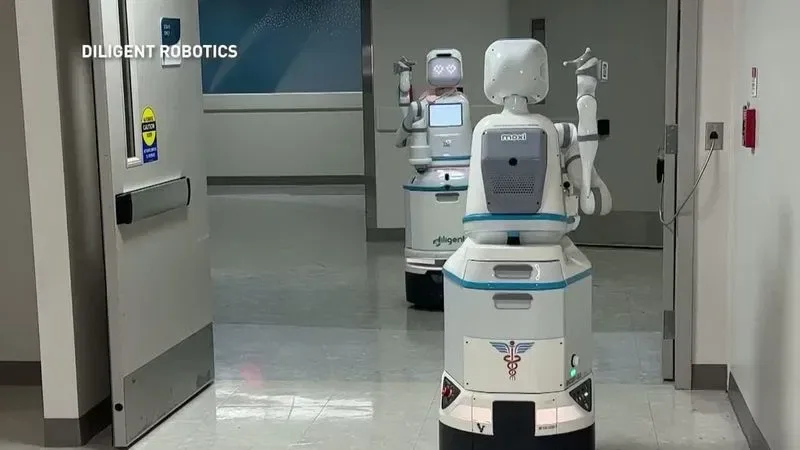
Diligent Robotics unveiled Moxi 2.0 on November 25, 2026, an upgraded version of its hospital delivery robot built after four years of hardware and software refinement on the original Moxi. The Austin-based company's fleet of 100 robots has completed more than 1.25 million autonomous deliveries across 25 hospitals nationwide, according to CBS Austin.
"The size of the AI model that we can put on Moxi 2.0 is just bigger; it can do more," said Diligent Robotics CEO Andrea Thomaz. She pointed to the time savings for nursing staff as the robot's core purpose, noting that "nurses can spend hours a day, miles per shift, walking around" on tasks Moxi can now handle instead.
What changed between Moxi 1 and Moxi 2.0?
Moxi uses five cameras and 3D lidar to navigate hospital corridors, elevators and patient floors without a fixed track or pre-mapped route for every trip. The core upgrade in version 2.0 is computing capacity: a larger onboard AI model lets the robot handle more complex navigation decisions and learn new routes faster than the original hardware allowed. Diligent describes this as a "data learning flywheel," where every delivery across the fleet feeds back into training data that improves how quickly new robots or new hospital layouts come online.
One concrete capability gain is elevator navigation, which Diligent says Moxi has only recently mastered reliably, since calling an elevator, waiting for the right car, and navigating in and out among people and gurneys is a harder perception problem than moving down an open hallway. Moxi announces its own tasks aloud and uses a signature "meep meep" alert to signal its presence to staff and patients, and hospital employees activate deliveries using a badge tied to pre-loaded task lists, so the handoff from a nurse's request to a scheduled run requires no manual programming.
Why does a delivery robot matter for nursing staff shortages?
Moxi's job is narrow by design: pharmacy runs, lab sample pickup and medication transport, the kind of walking-heavy errands that eat into a nurse's shift without requiring clinical judgment. Diligent's pitch is that offloading those miles gives nursing staff more time at the bedside, a argument that has gained traction as hospitals face persistent staffing shortages and rising labor costs.
At 100 robots across 25 hospitals, Diligent's fleet remains small next to the scale of hospital automation efforts from larger medtech players, but its 1.25 million completed deliveries give it a longer operational track record than many newer hospital robotics entrants. The company competes in a crowded hospital logistics space that includes Ottonomy's delivery robots and various in-house hospital automation pilots, but Diligent's advantage is specialization: Moxi does one job, repeatedly, across a growing number of sites, rather than attempting broader hospital-wide automation. Whether the bigger AI model in Moxi 2.0 meaningfully cuts new-hospital onboarding time, which Diligent frames as the real payoff of its data flywheel, will depend on how quickly the next wave of hospital deployments ramps up.