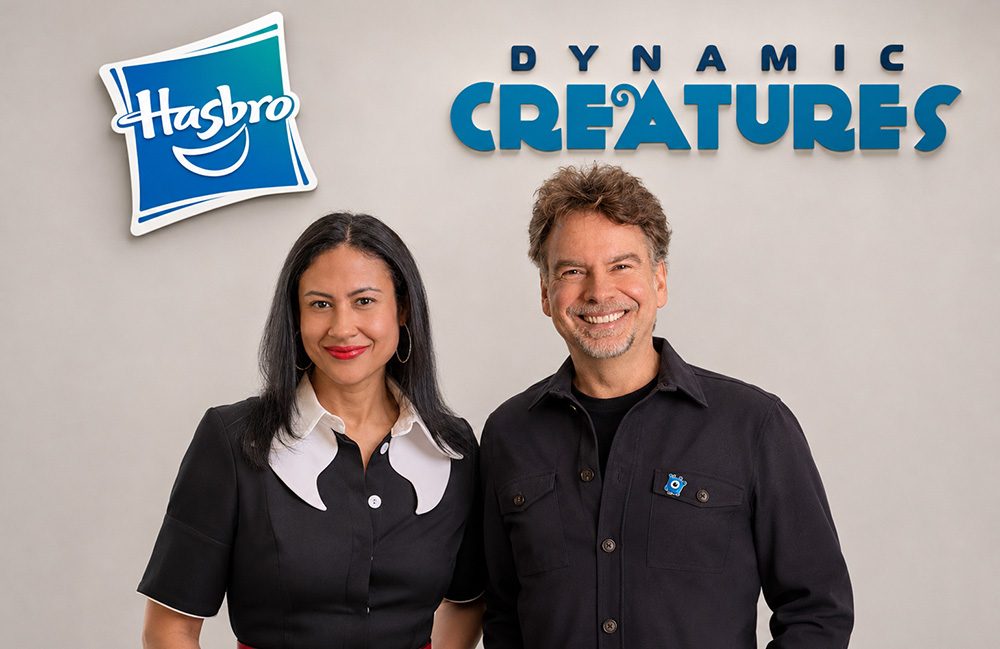
Dynamic Creatures, the Boston Dynamics-linked entertainment robotics company, announced a partnership on November 10 with Sixth Wall Studio, the AI studio Hasbro launched in June 2026, to jointly build interactive character robots for theme parks, resorts, hotels, cruise ships and retail spaces. The deal combines Sixth Wall's character-authoring platform with Dynamic Creatures' physical robots, starting with Hugo, the company's first production character.
Hugo is a purple, furry, horned robot built on 43 actuators and the SnowJay robotics AI platform, capable of moving freely among guests, gazing, gesturing and reacting in real time. "Today CharacterOS is focused on voice, and Dynamic Creatures is focused on the physical embodiment," said Marc Theermann, co-founder and CEO of Dynamic Creatures, according to The Robot Report. Sixth Wall Studio CEO Roberta Thomson said the partnership "takes that ambition into the physical world," extending the studio's Behavioral Licensing framework from voice interfaces into physical robots. No financial terms were disclosed.
Why Character Licensing Is the Wedge Into Service Robotics
Theme parks and hospitality venues are one of the few commercial settings where a robot's imperfect autonomy is a feature rather than a liability: guests expect scripted, bounded interactions rather than open-ended task completion, and a human-in-the-loop safety model, which Theermann says both companies rely on, is culturally acceptable in a character costume where it would be a dealbreaker on a factory floor. That makes licensed-IP robots a lower-risk commercial path than warehouse or manufacturing deployments, where humanoid robots are still proving reliability under scrutiny from operators focused on throughput and safety audits.
For Hasbro, the deal is a bet that its character library — built over decades in toys, games and media — has more commercial life in physical form than in voice assistants alone. For Dynamic Creatures, barely two months out of stealth, pairing with a recognizable IP owner solves the chicken-and-egg problem that most entertainment robotics startups face: building emotionally engaging characters without an existing fan base to draw on.
A Narrow but Growing Lane Next to Industrial Humanoids
Dynamic Creatures sits apart from the Boston Dynamics, Figure, Agility and Apptronik race toward warehouse and factory-floor humanoids. Its parent-company lineage gives it access to mobility and balance expertise without the pressure to hit industrial-grade uptime or payload benchmarks those competitors chase. Disney's recent trials of FieldAI robots for park logistics show theme park operators are already experimenting with physical AI, but Dynamic Creatures and Sixth Wall are targeting the guest-facing, character side of that market rather than backstage operations.
The partnership also tests how far licensed entertainment robots can scale beyond one-off installations. Success will depend on whether Hugo-style robots can be deployed across multiple venues at a cost hospitality operators are willing to pay repeatedly, rather than as a novelty attraction. If it works, expect other IP holders to look for similar physical-embodiment deals rather than building robotics expertise in-house.