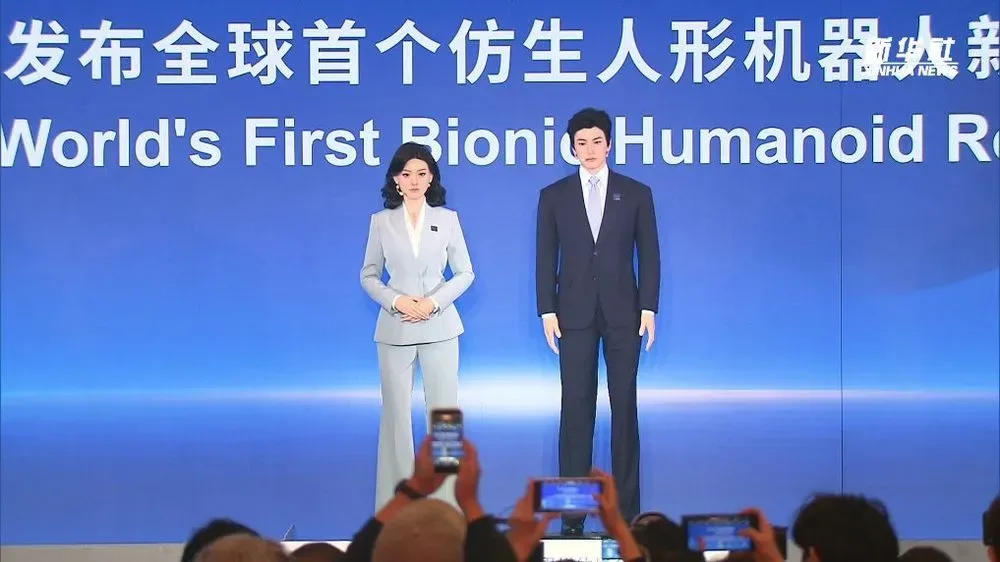
Xinhua News Agency and robot maker UBTECH have unveiled two full-scale humanoid robots built to work as news anchors, a first for live broadcast. The pair, named Xinyan and Xinyu, were shown at the 7th World Media Summit in Beijing and are being positioned for ongoing use in Xinhua's news operations, according to Xinhua.
Both robots are built at 1:1 human scale and wear tailored suits, greeting audiences the way a human host would. Chinese film director Zhang Yimou served as chief designer of their visual identity, an unusual pairing of entertainment design and robotics engineering for a state broadcaster.
What makes these robots different from earlier AI news presenters?
China has experimented with AI anchors before, including a 2018 Xinhua system that relied on video synthesis without any physical body. Xinyan and Xinyu are physically embodied: they stand on a studio floor, gesture, and deliver broadcasts in person rather than existing only as rendered video.
The robots run on what Xinhua calls an integrated "brain-expression-control" pipeline. UBTECH supplied the hardware layer, including bionic skin, embodied AI hardware, and its mass-production process, while Xinhua supplied the knowledge layer through a purpose-built AI system called Xinhua Yudian, trained specifically on current-affairs and political information.
How do they decide what to say on air, and can they go off-script?
The anchors retrieve information in real time from a vetted set of sources rather than generating answers freely, which Xinhua says is meant to reduce the risk of AI hallucinations appearing in a news broadcast. They are designed to read prepared news segments, respond to questions from journalists on site, and deliver content in multiple languages.
Human editors retain control over what the robots broadcast, according to reporting on the unveiling. That distinguishes the project from a fully autonomous news generator: Xinyan and Xinyu are presenters sitting on top of an editorial process that is still run by people.
Why does this matter beyond a single broadcast gimmick?
The project is a public showcase of UBTECH's full technology stack, spanning bionic skin, embodied intelligence hardware, operating systems, emotion-driven language models, and manufacturing at scale. UBTECH has spent the past two years pushing from industrial and consumer humanoids into more specialized, branded applications, and a state news agency partnership gives it national visibility inside China.
For Xinhua, the robots extend a years-long push into AI-generated and AI-assisted journalism, moving from synthesized video anchors to a physical presence that can appear at events, answer questions, and interact with reporters directly. Xinhua has said it sees future uses in educational settings, cultural exchange events overseas, and even deep-space-exploration contexts, though no deployment timeline for those uses has been given.
What happens next?
Xinhua has not published a deployment schedule beyond the initial unveiling at the World Media Summit, nor has it disclosed unit costs or how many broadcasts the robots have delivered live versus in demonstration. The next test will be whether Xinyan and Xinyu move from a single staged debut into recurring on-air duty, which would make them one of the first robots with a standing editorial role at a major news organization.