The U.S. Marine Corps has awarded Los Angeles-based Epirus an $11 million contract to integrate its Leonidas high-power microwave weapon onto the fielded Marine Air Defense Integrated System (MADIS), the service announced Monday, taking the first step toward a production counter-drone capability that can defeat the fiber-optic guided drones now saturating the Ukraine battlefield.
What HAVOC Is And Why It Matters
The award covers the High-power Microwave Autonomous Vehicle Operational Capability (HAVOC) program and was routed through the Office of Naval Research. Unlike RF jammers, which are useless against fiber-optic FPV drones that receive commands over a physical spool of optical cable, Epirus's Leonidas induces electrical failures directly in a drone's flight controller, ESC and power electronics. That mechanism also works on GPS-denied autonomous drones — the next threat class defence planners are worried about.
Bolt-On To MADIS, Not A Standalone Truck
MADIS is the two-vehicle JLTV pair the Marines fielded to 1st Low Altitude Air Defense Battalion in December 2025, pairing a Mk1 kinetic vehicle (Stinger + 30 mm) with a Mk2 sensor and jammer node. HAVOC adds a third engagement layer: EW first, HPM for anything that survives jamming, then kinetic. Epirus's press release calls out a universal sled mount so the HPM array can slide between manned and unmanned ground vehicles rather than living on a dedicated trailer, as its earlier ExDECS prototype did.
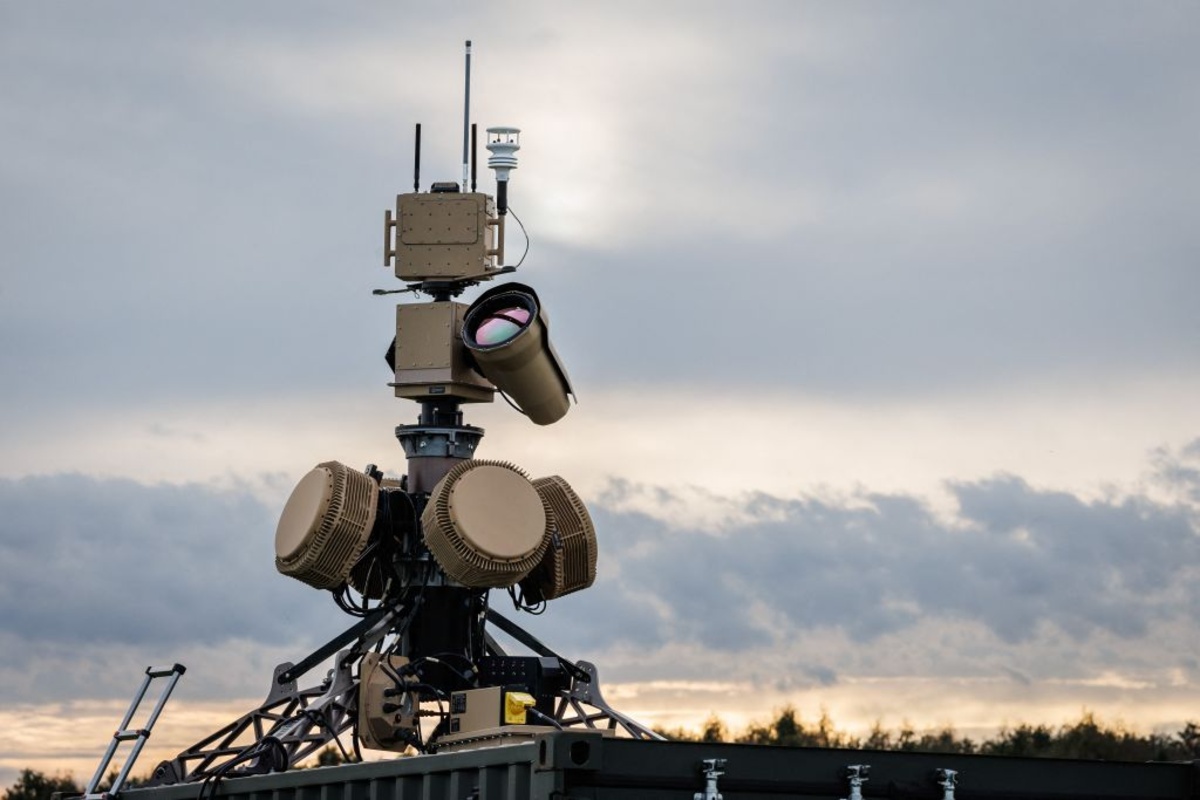
From ExDECS To Program Of Record
Epirus delivered the ExDECS trailer prototype to NSWC Dahlgren in April 2025. HAVOC is the Marine Corps' signal that it wants that capability on the vehicles it actually deploys. The contract includes training, service and sustainment, plus an option for an additional system, with delivery expected in early Q2 2027. Sister services are watching: the Army has already sunk $109 million into Leonidas across two Indirect Fire Protection Capability contracts, and Epirus's DHS-eligible counter-UAS work continues in parallel.
The One-To-Many Argument
Directed-energy lasers can only engage one drone at a time and choked on vibration and heat when the Army tried to bolt a 50 kW system onto a Stryker. HPM is different: a single burst can deposit enough energy across a volume of airspace to knock down a coordinated swarm. In September 2025 Leonidas defeated 61 of 61 drones at a live-fire demo, including a 49-drone swarm downed with a single burst. If the MADIS integration holds, the Marines get the first ground vehicle in U.S. service that can address swarm attacks without spending a Stinger per drone.
Reporting based on coverage from Tech Times, DefenseScoop and Epirus press materials.