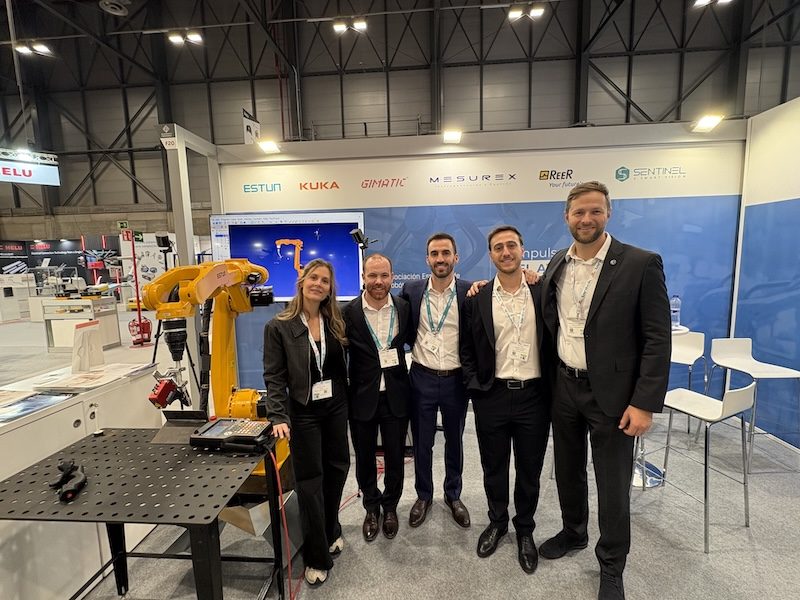
ESTUN Robotics and RoboDK announced a strategic partnership on November 12, 2026, at DFactory Barcelona, integrating ESTUN's industrial robots directly into RoboDK's simulation and offline programming platform. The deal follows months of joint technical work and targets one of automation's most persistent friction points: the time it takes to simulate, program and commission a robot cell before it ever touches a real part.
Under the agreement, ESTUN robots are now fully supported in RoboDK's software library, meaning integrators can simulate robot motion, test reach and cycle times, and generate robot programs before installing any hardware. RoboDK's customizable post-processors let system integrators adapt how programs are generated to match specific application needs, rather than relying on ESTUN's own proprietary programming tools alone.
A China-Europe industrial robot play
ESTUN, which positions itself as China's largest industrial robot manufacturer, has been building out its European operations, including a factory in Poland, and the partnership is set to extend there next. "RoboDK should be our reference platform for complete robotic simulations," said Ignacio Moreno, ESTUN's sales director for Iberia, citing ease of use and integration flexibility. RoboDK CEO and founder Albert Nubiola said ESTUN robots are "fully integrated into our RoboDK platform, ready for simulation and offline programming right from the start."
Why simulation partnerships matter for robot adoption
Offline programming and simulation tools have become a competitive battleground as robot makers try to lower the barrier for small and mid-sized manufacturers who lack dedicated robotics engineers. Fanuc, ABB, KUKA and Universal Robots all maintain their own simulation ecosystems or partnerships with third-party platforms like RoboDK, and a Chinese manufacturer gaining that same software compatibility makes it easier for European integrators to treat ESTUN hardware as a drop-in alternative rather than a bespoke install. For ESTUN, the deal is also a signal of intent: the company is leaning on software partnerships rather than price alone to win share in a European market still dominated by established European and Japanese robot brands. ESTUN applications engineer Marc Pujolar said watching the two teams work through the integration was "truly inspiring," a detail that points to a technical collaboration, not just a logo-swap announcement. The next milestone to watch is whether the partnership extends, as planned, to ESTUN's Polish factory, and whether other Chinese robot makers follow with similar simulation-software tie-ups of their own.