
Exclaim Robotics, a Zurich-based startup building autonomous mobile robots for the rack-side maintenance of AI data centers, exited stealth on August 4, 2026 with $4.95 million in pre-seed funding. Founderful and Playfair Capital co-led the round, with participation from Kindred Capital, HCVC, Tiny Supercomputer Investment Company, ACE & Company, Amino Collective and angel investors.
Robots aimed at 800V DC racks
Founded in 2024 by former Microsoft roboticist Helen Oleynikova, Exclaim is targeting the maintenance and safety problems opening up as AI facilities move to denser power systems, liquid cooling and 800-volt direct-current distribution inside the rack. “It’s one of the fastest-evolving industries in physical infrastructure, where increased power densities are running right up against the laws of physics,” Oleynikova said in a LinkedIn post announcing the round. “This poses many safety questions, and we think robots are the answer.”
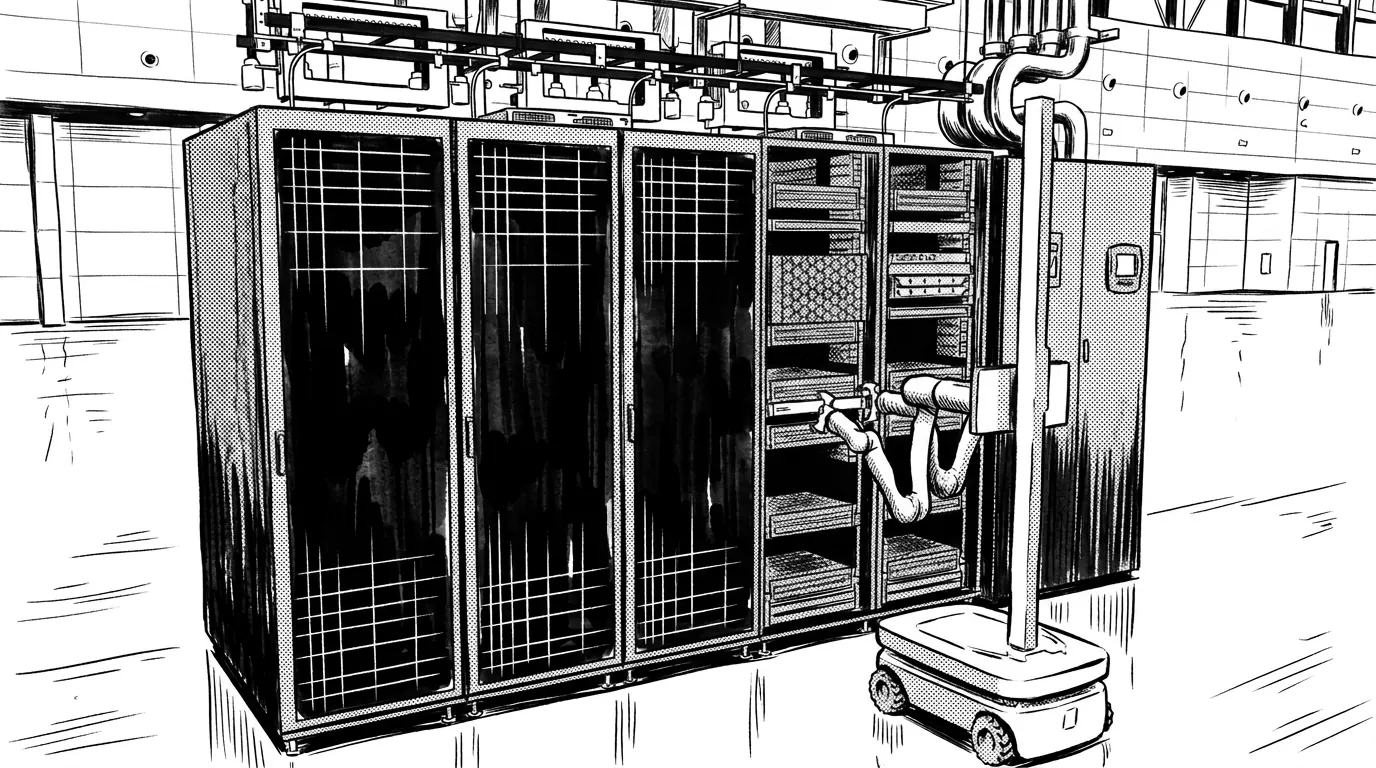
The company’s first robot focuses on dexterous manipulation tasks that software alone cannot solve: cleaning and swapping bent optics, reconnecting copper cabling and re-seating drives precisely on live racks. When confidence in a given skill is low, the system asks for teleoperation rather than risking a critical incident, then learns the recovery for next time.
Lights-out halls, warmer facilities, tighter security
Exclaim argues that pulling routine maintenance off human staff unlocks several second-order benefits for hyperscale operators. Data-halls kept comfortable for humans can run hotter, cutting cooling energy. Uptime improves because parts get replaced when hardware asks for it, not when the schedule allows. Physical access is a security surface, so shrinking floor traffic tightens the perimeter. And robots can service sites tucked next to remote solar farms or even underwater installations, unlocking new geographies for AI compute.
Where the money goes
Exclaim plans to use the pre-seed capital to move into its first dedicated workspace, buy robot arms and expand engineering. The company is currently recruiting a robotics hardware engineer and a machine-learning engineer, drawing on a founding team with backgrounds at NVIDIA, Microsoft, Google and ETH Zürich. The eventual ambition, Oleynikova has said, extends beyond compute halls to any hazardous, remote or hard-to-reach infrastructure.
The raise slots into a busy stretch of physical-AI infrastructure funding. It arrives days after HappyRobot's $150 million Series C for logistics AI agents, and follows the June exit of robotics data-infrastructure startup XDOF with $70 million to build the training pipelines robot foundation models rely on. Sanctuary AI and other physical-AI companies have similarly leaned into large late-stage rounds in 2026 as investors bet on robots that can act in messy real-world environments.
Reporting based on coverage from AI Insider, Sifted, TechFundingNews and Exclaim Robotics’ own site.