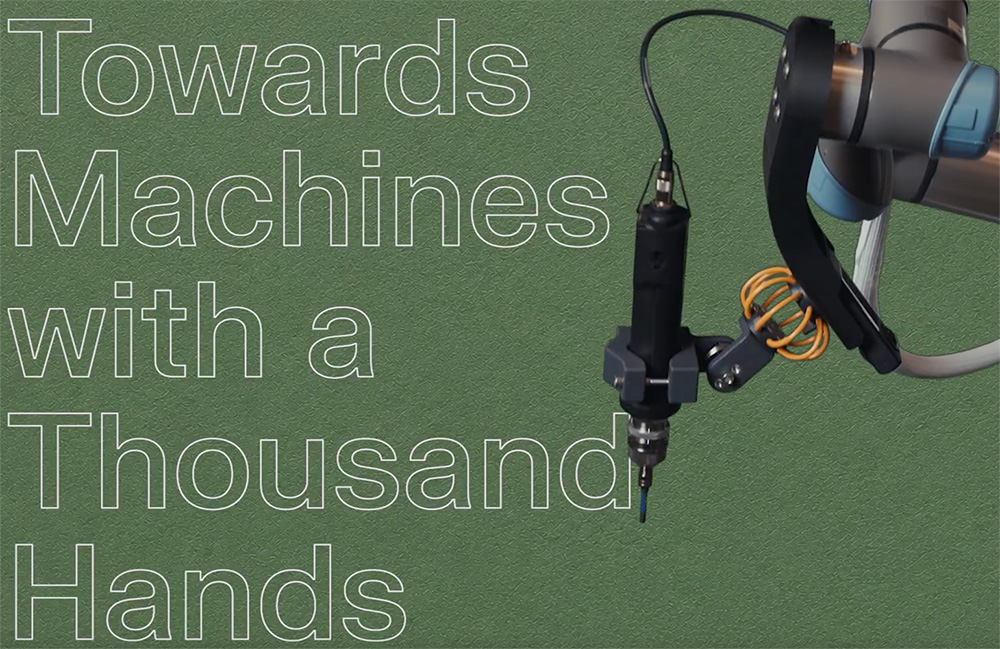
Generalist has scaled its GEN-1 embodied foundation model to work with a "toolbox of a thousand hands" — from five-fingered anthropomorphic hands to power screwdrivers, whisks, tongs, scrapers, box cutters and roughly 9,000 variations of the company's standard two-finger grippers — arguing that a single base model can now learn sensorimotor policies across radically different ways of touching the world.
Half a million hours across 9,000 end effectors
The Robot Report first surfaced Generalist's latest update on July 24, showing GEN-1 in action across specialized tools with new modes of actuation and camera positions inspired by real commercial use cases. The company said GEN-1 is pretrained on its in-house robotics dataset spanning more than 500,000 hours of real interaction data across the roughly 9,000 end-effector variations — a dataset designed to expose the model to a broad range of contact physics, forces, and friction regimes.
Every hand is a different language
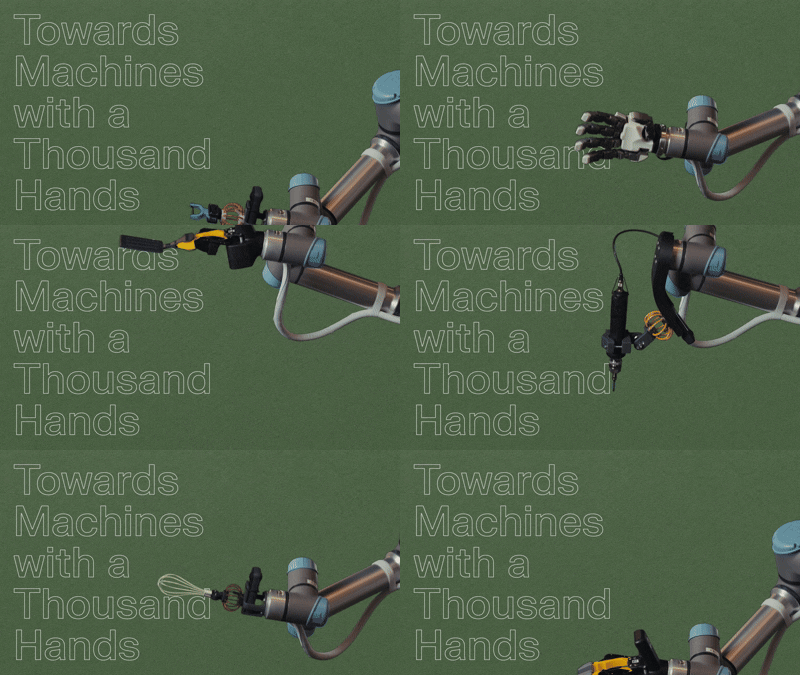
Generalist's framing borrows from language modeling: just as a multilingual LLM shares knowledge across tongues, training on many hands teaches a single physical intelligence to abstract what is universal (contact, geometry, friction) from what is embodiment-specific (a tape dispenser vs. a peeler vs. a plasma welding nozzle). Some hands, the company noted, "carry more real-world weight" — its own two-finger grippers still dominate, much like English in today's LLMs.
Task-vector diagnostics
The team is also using task-vector analysis, comparing pretrained GEN-1 to the same model after fine-tuning on a new tool, to visualize which sensorimotor systems (perception, harmonic reasoning, actuation) shift most for each embodiment. Whisks, for example, shift sensor-processing weights much more than peelers do, likely because the model has to perceive thin wire geometry — a signal that Generalist is using to steer future data collection.
Adapting on the fly
The most striking demo: with GEN-1 mid-rollout, the team physically swapped the robot's end effector — and the same model kept running, perceiving the new tool and finding a new trajectory and contact strategy to reach the same goal. The company's read is that GEN-1 has moved past memorized manipulation strategies toward "a prior over how shapes and contact surfaces interact with the world."
A Cambrian explosion for robot hands
Generalist argues the future of manipulation looks less like a five-fingered humanoid hand and more like a toolbox that can be recombined and scaled. That thesis is timely: Zurich's mimic Robotics just unveiled its M1 hand and U1 exoskeleton for dexterous data collection, and Travis Kalanick's ATOMS raised $1.7B this week to scale industrial physical AI. Foundation models that can "swap hands" without retraining could be a major unlock for those platforms.
Reporting based on The Robot Report's July 24, 2026 coverage and Generalist AI's "Towards Machines with a Thousand Hands" release.