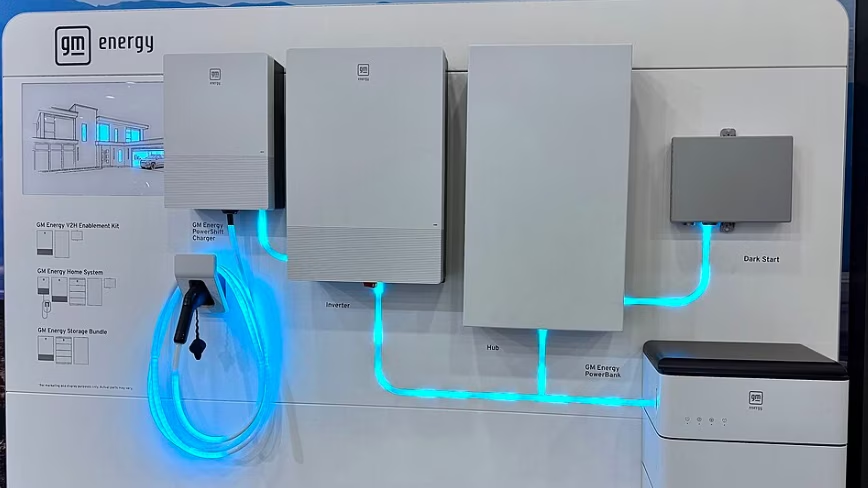
General Motors has unveiled three battery deals that pull it firmly into the AI data center and grid-storage business, partnering with sodium-ion startup Peak Energy, signing a lithium-iron-phosphate supply agreement with LG Energy Solution and buying a 7.2 MWh second-life battery system from Redwood Materials. The combined push is the clearest signal yet that GM sees its $900 million battery R&D investment as a multi-market business rather than an EV-only program.
Sodium-ion with Peak Energy
The most technically ambitious piece is the Peak Energy partnership. GM will co-develop sodium-ion battery cells at its Battery Cell Development Center in Warren, Michigan, targeting trial production by 2028. GM keeps exclusive manufacturing rights for the cell, while Peak integrates it into its own stationary energy-storage systems. Sodium-ion cells trade energy density for cost, longer life and lower thermal risk - poor for cars, but well-matched to data center backup and grid services. No Western automaker has committed to sodium-ion development at this scale, and Peak is already operating a pilot line in Escondido, California and building a 10 GWh factory.
LFP cells flow to LG Energy Solution
The LG deal fills the gap until sodium-ion is ready. GM will supply lithium-iron-phosphate cells manufactured at the Warren development center to LG Energy Solution, which will integrate them into energy-storage systems for data center and utility customers chasing the surge in AI power demand. LFP is already the dominant chemistry in stationary storage and gives GM an immediate revenue stream from cells it had built only for vehicles.

Redwood Materials at the proving ground
GM also bought a 7.2 MWh battery energy-storage system from Redwood Materials that will be installed at the Milford Proving Ground in Michigan for backup power and peak shaving. Redwood, founded by Tesla co-founder JB Straubel, has pivoted from pure battery recycling into grid-scale energy infrastructure built around second-life EV batteries. It already operates a 12 MW, 63 MWh microgrid at a Crusoe AI data center in Sparks, Nevada - the largest second-life deployment in North America.
Why it matters
GM's three-deal push lands the same week as Factorial Energy's Nasdaq debut, BYD and rivals' 2027 solid-state roadmaps and Waymo's plan to send retired robotaxi batteries to the grid via B2U Storage. Together they show the lithium-ion world rapidly forking into two parallel races: high-density chemistry for vehicles and low-cost, second-life or sodium-based chemistry for stationary storage. GM is one of the first Western automakers to chase both at once.
Reporting based on coverage from TechCrunch, The Next Web, Detroit News, CNBC and Yahoo Finance.