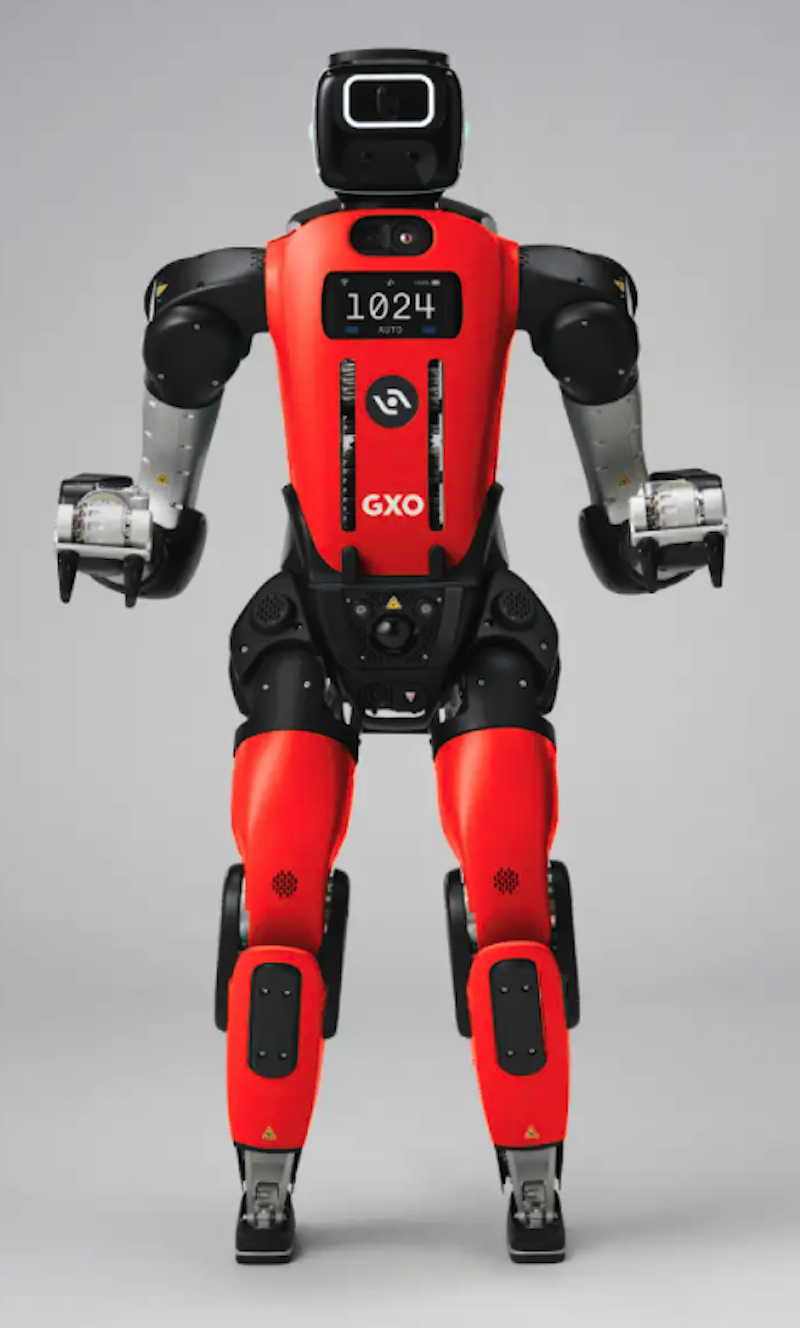
Logistics operator GXO is expanding its use of Agility Robotics' Digit humanoid to two new US facilities, in Statesville, North Carolina, and Lebanon, Tennessee, with operations set to begin in early 2027. The expansion follows Digit's work at a GXO facility in Georgia, where the robot has moved more than 100,000 totes since June 2024, and comes as Agility says more than 30 companies are now in active discussions to deploy the humanoid.
What will Digit actually do at the new sites?
At Statesville and Lebanon, Digit will handle repetitive material-handling tasks in e-commerce fulfillment operations, the kind of tote-moving and case-handling work it has already been performing in Georgia. The new deployments will run on the current Digit 4 hardware, with GXO planning to upgrade to the newer Digit 5 once it becomes commercially available.
The Georgia-to-Statesville-and-Lebanon pattern reflects what Agility has described as its go-to-market strategy: prove out a deployment at one site, then expand it across a customer's other facilities once the economics and reliability are established.
How big is Agility's broader customer pipeline?
Agility says it now has more than 30 prospective customers in active discussions across manufacturing, automotive, aerospace, defense, logistics and consumer products. Three additional manufacturing customers, including a global automaker that sells more than 3 million vehicles annually, an auto component supplier, and a consumer products company, are running paid evaluation programs, though Agility has not named them. Publicly disclosed customers now include GXO, AGCO, Toyota Motor Manufacturing Canada, Schaeffler and Mercado Libre, and Agility says two early-stage conversations are underway with US Armed Services branches around subcontractor roles.
Why does this matter beyond one warehouse operator?
Warehouse and logistics work remains the most mature commercial use case for humanoid robots, ahead of factory floors or retail, because tote and case handling is repetitive, well-defined and already instrumented with conveyor and sortation infrastructure that a bipedal robot can slot into. GXO's willingness to triple its Digit footprint, rather than simply renew a single pilot, is a stronger signal of commercial viability than a press release listing new logos, since it reflects an existing customer putting more capital behind the technology after seeing it run for over a year.
It also lands at a moment when Agility is under more scrutiny than usual: the company's SPAC merger with Churchill Capital Corp XI is expected to close in the fourth quarter of 2026, after which it will trade on Nasdaq as AGLT. Investors evaluating that listing will be looking for exactly this kind of evidence that paying customers are expanding deployments rather than letting pilots quietly lapse.
What's the timeline for Digit 5 and production capacity?
Agility says it has more than $300 million in committed multi-year orders tied to Digit 5, with early customer access expected in the first half of 2027 and general availability by the end of that year. The robots will be built at Agility's RoboFab facility in Salem, Oregon, a 70,000-square-foot plant designed for annual production of up to 10,000 units. Whether that capacity gets used depends on how many of the 30-plus companies now evaluating Digit convert from pilots to the kind of multi-site expansion GXO just signed.