Chinese battery-storage specialist Hithium has stepped past its all-lithium roadmap with the launch of the ∞Cell N785Ah — a 785Ah sodium-ion (Na-ion) prismatic cell — alongside a companion 4 MWh utility-scale battery-storage system called the ∞Power N4.0MWh. The company is pitching the pair at 2- to 8-hour grid-firming applications where lithium iron phosphate has previously ruled unchallenged.
The Cell: 20,000 Cycles, 30-Year Life
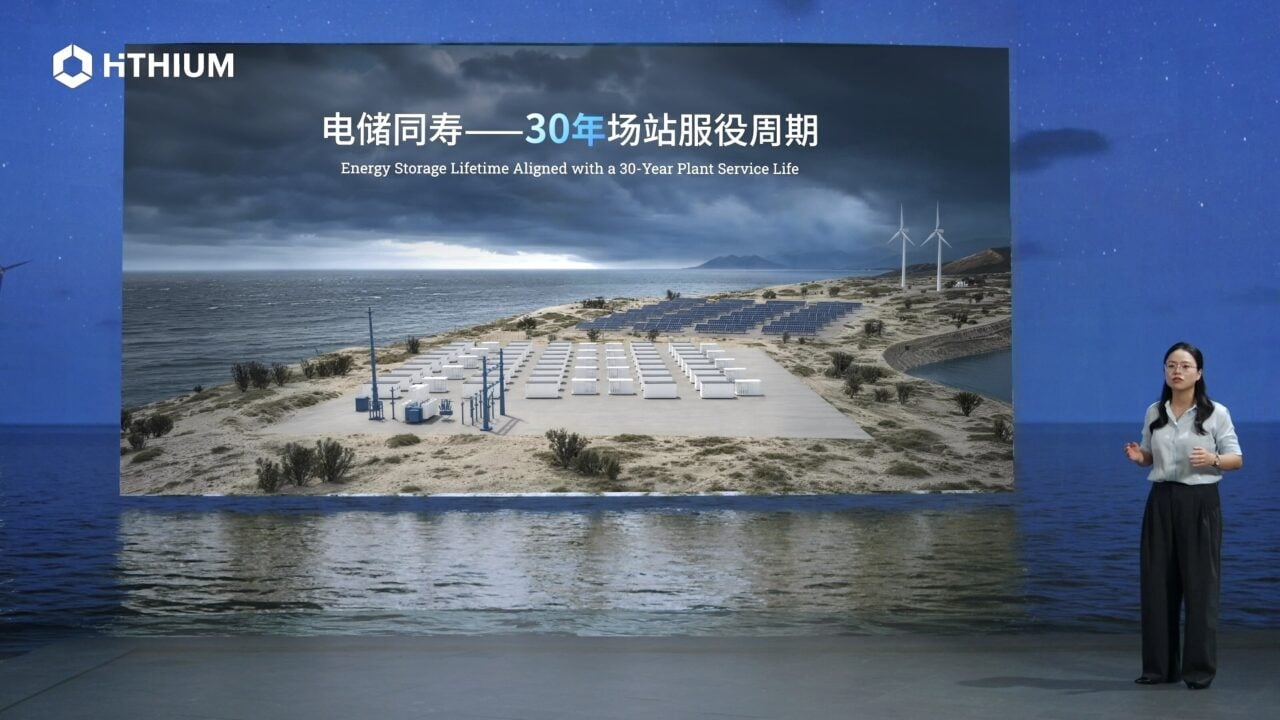
The ∞Cell N785Ah is built on a sodium iron phosphate pyrophosphate (NFPP) cathode, a chemistry Hithium says lets it hit 20,000 cycles and roughly 30 years of expected operational life. Sodium-ion has been positioned as a lower-cost, lower-flammability, better-cold-weather alternative to LFP; the trade-off has historically been energy density and cycle life. Hithium says its NFPP formulation and 785Ah cell format close enough of that gap to be competitive in duration-heavy grid deployments. Research director Dr Aileen Wang framed the launch bluntly: "We did not just follow lithium-ion. We wanted to explore where lithium-ion has yet to go."
The BESS: 4 MWh, 800V-1500V PCS Compatible
The ∞Power N4.0MWh packages the new cell into a stacked-cell 4 MWh block with a dedicated BMS that Hithium claims achieves 2.5% state-of-charge accuracy — a figure that matters in merchant markets where dispatch precision translates directly into ancillary-service revenue. The system is rated to run against 800V through 1500V power-conversion systems, keeping it compatible with the current generation of grid-scale PCS from suppliers such as Sungrow, Power Electronics and Fluence.
Sodium-Ion's Real Test: The Grid
Sodium-ion has been talked about for years, but 2026 is the year it lands in serious utility-scale gear. Rival CATL has been pushing its own TENER Sodium platform, and the technology plays into national supply-chain hedges where lithium and cobalt exposure is politically sensitive. For Hithium — already building a €400M gigafactory in Navarre, Spain and supplying grid-forming BESS in Australia — sodium-ion is a hedge that keeps the company relevant if lithium prices spike again or if Western tariff regimes tighten on Chinese lithium exports.
Reporting based on coverage from Energy-Storage.News.