
Huawei pulled the covers off its next-generation AI computing cluster, the Atlas 960 SuperPoD, at Huawei Connect 2026 in Shanghai on September 17, 2026, moving commercial availability of the underlying Ascend 960DT accelerator three quarters ahead of schedule and doubling down on a self-declared "Tau Scaling Law" that Huawei says will match Nvidia generation-for-generation into 2029.
4,096 accelerators, 8 exaflops, one rack architecture
Huawei is stacking 4,096 Ascend 960 accelerator cards into a single Atlas 960 SuperPoD node, claiming 8 exaflops of FP8 compute and 1 petabyte of HBM memory per SuperPoD — roughly twice the raw compute of the Atlas 950 it replaces. Near-Package Optics (NPO) sit at the heart of the design, replacing pluggable optical modules with in-package silicon photonics and cutting interconnect power by more than 550 kilowatts per cluster while opening the door to 12.8 Tb/s links.
Ascend 960DT accelerated to Q1 2027
The Ascend 960DT training chip is being commercialised in Q1 2027, three quarters ahead of the Q4 2027 target Huawei laid out in its earlier Ascend 950DT briefing, with an Ascend 960PR inference variant following in Q3 2027. Huawei rotating chairman David Wang described the pace bluntly: "One generation per year," with Ascend 970 in 2028 and Ascend 980 in 2029.
Betting on China's AI market vacuum
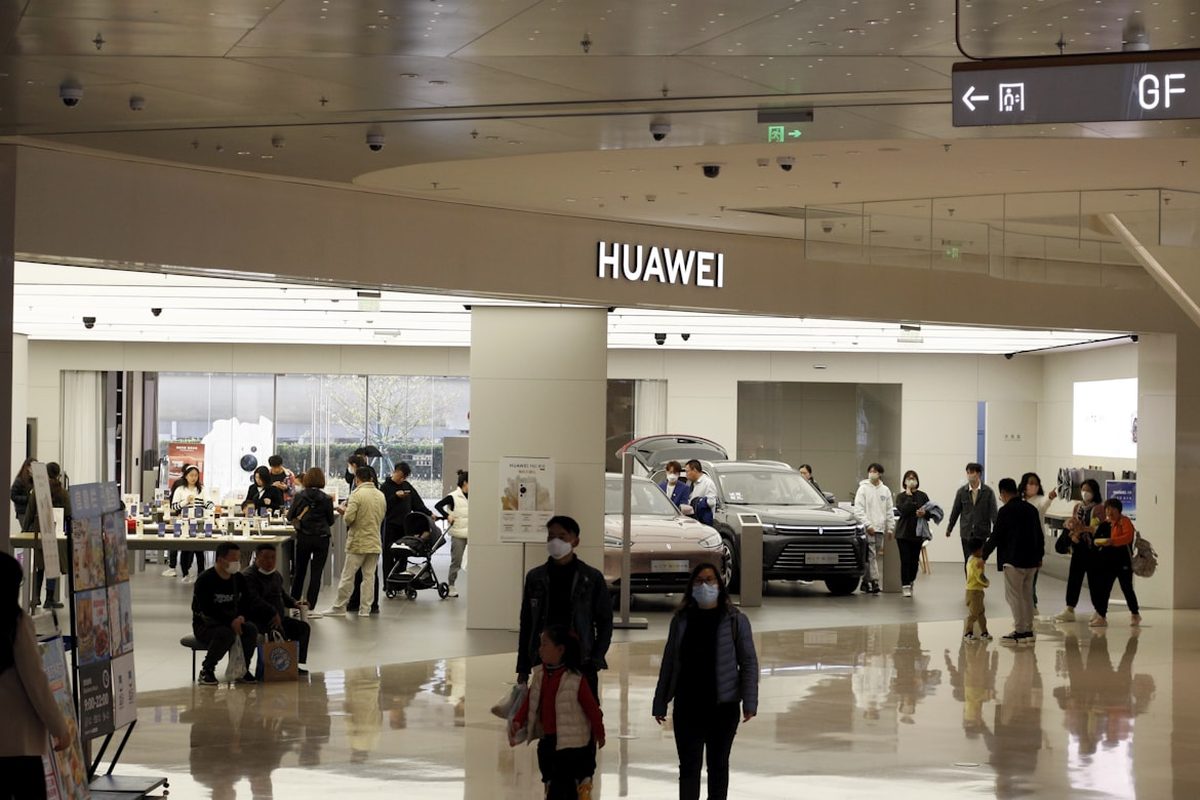
The roadmap lands as Nvidia's China share is projected to fall to roughly 8% in 2026, down from about 40% a year earlier, with CEO Jensen Huang telling investors Beijing's tighter posture makes China "a $50 billion opportunity" that Huawei is effectively conceded. Huawei is filling that vacuum: the Atlas SuperPoD is the reference stack behind Chinese hyperscaler AI factory builds and mirrors the compute density strategy underpinning Anthropic's Queensland Zerra DC in the West.
Standardising the optics stack
Huawei also kicked off an OIF-approved international standard project for 12.8 Tb/s NPO interconnect first greenlit in May 2026, an effort to make Ascend-native networking the default reference for allied AI data-center builds and to blunt Nvidia's NVLink/Spectrum-X lock-in. The move complements Huawei's earlier consumer chip disclosures around the Kirin 9050 Pro and its Tau/LogicFolding packaging, and signals that the Ascend roadmap is now the primary vehicle for Huawei's frontier AI story.
Reporting based on coverage from TechTimes, Dataconomy, Huawei Central and LightCounting.